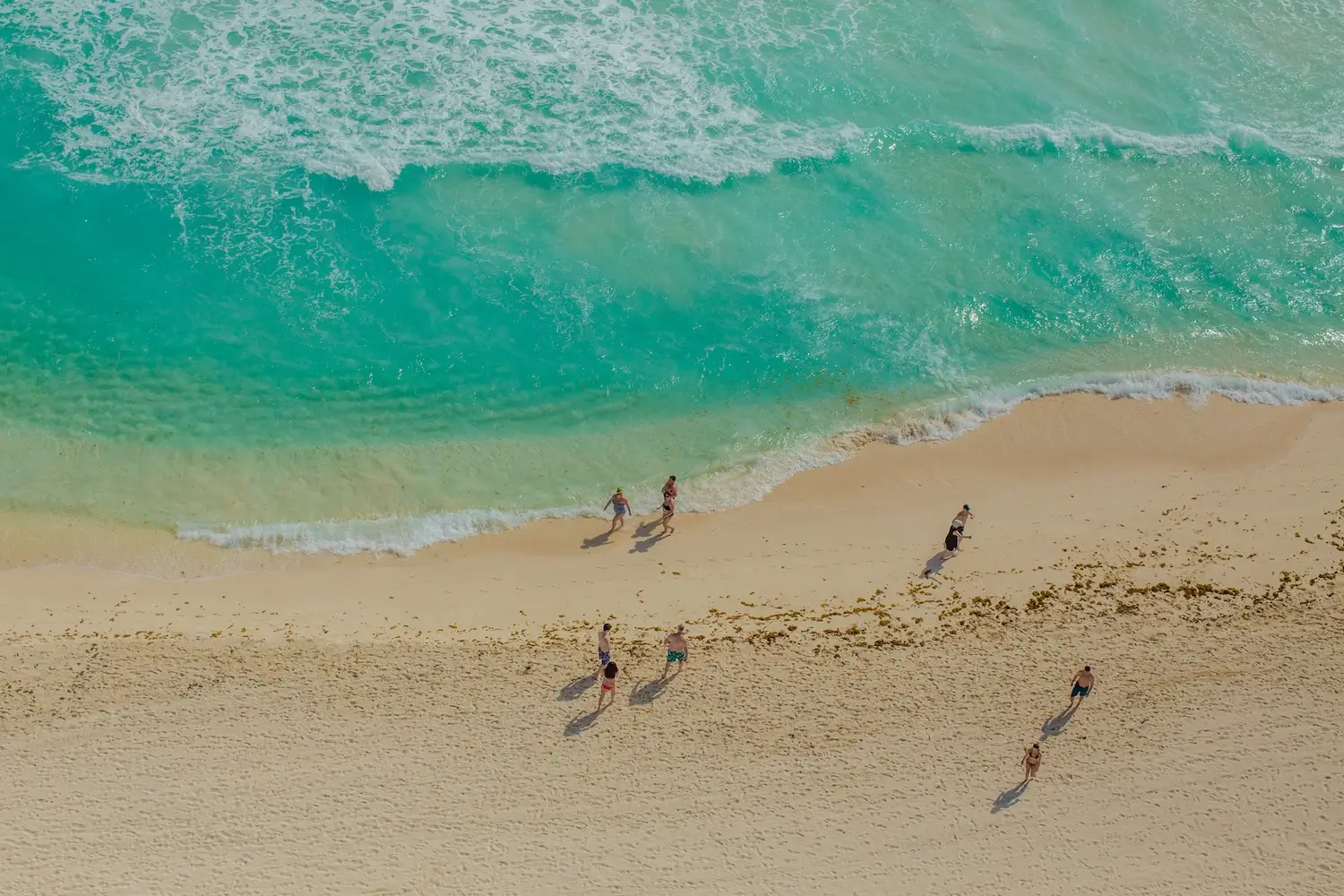
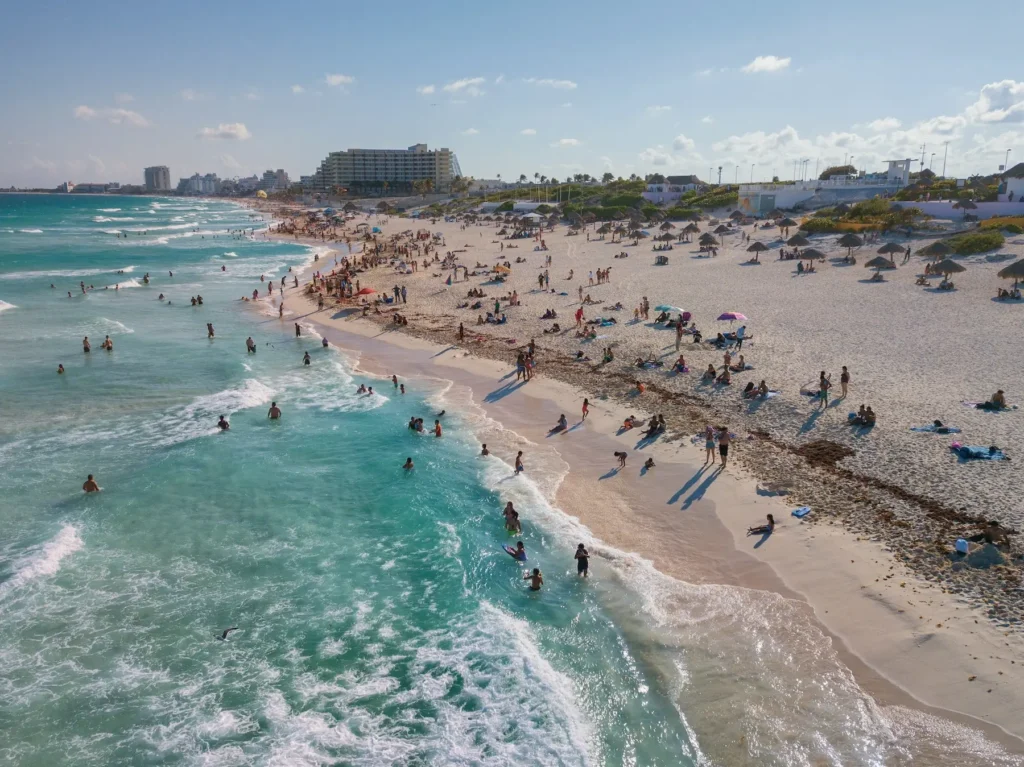
During my long trips around the world I have never told someone I’m from Cancun and have them wonder where that is. That’s crazy if you think about it. Cancun is one of those places almost everyone has heard of, and for most tourists, Cancun is about the beach, resorts, and basically getting drunk. It always felt to me like the kind of place people go to not really be in Mexico. And while that version of it does exist, that was almost never my Cancun. The real Cancun, the one I have woken up to most mornings of my life, has a completely different rhythm.
The Cancun I know looks more like, yes of course, weekends chilling at the beach, but also esquites from a cart pushed from a señor selling elotes, random boat days with friends, some guy selling bread from the back of his truck, a lagoon full of crocodiles, crowded buses under the burning sun, high electricity bills due to the constant running of the air-con… you get the point.
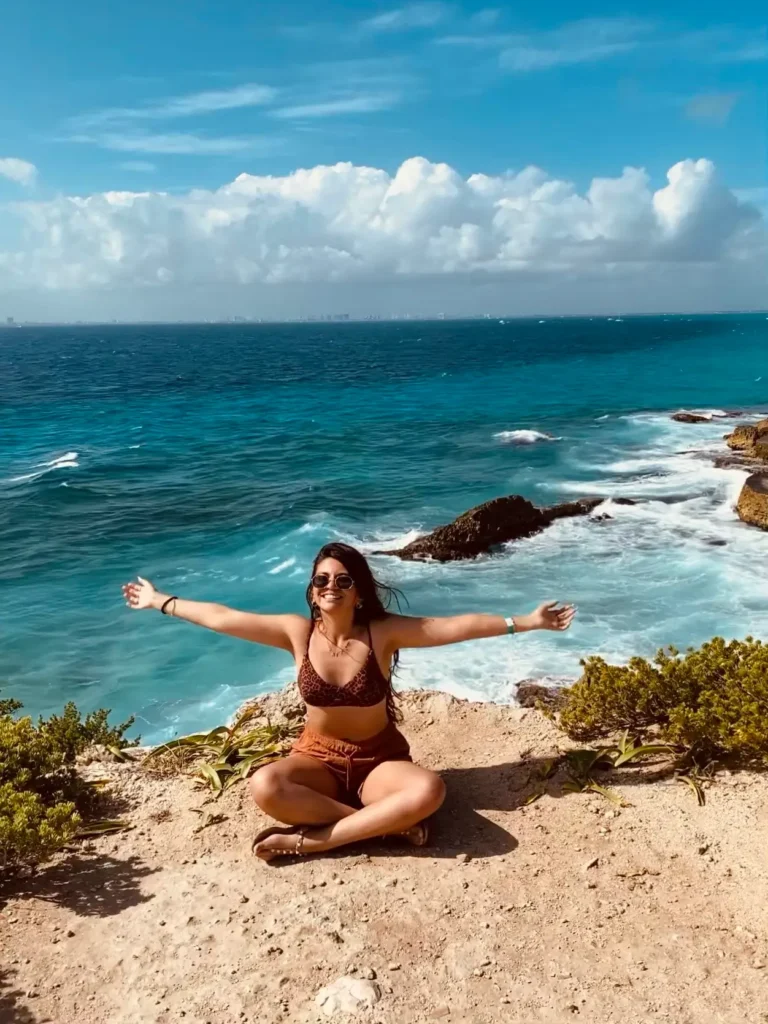
I grew up here and over the 22 years I spent living in Cancun I’ve watched it evolve from a relatively small touristy city surrounded by mangroves into one of Latin America’s biggest tourist destinations. And so, given my advanced-level knowledge about this city, I’ll try to give you the most complete and accurate guide of Cancun you will find.
So, hola! My name is Danitza, a “slowmad” and photographer from Cancun who has been slow-traveling the world for over four years now. Welcome to my travel blog. Here, you’ll find valuable info about the places I have visited and stories about my journey toward finding work-life balance while maintaining a nomadic-travel lifestyle.
This guide is not about the five-star version of Cancun. If you’re researching which all-inclusive has the best buffet or where to find the nicest swim-up bar, this is your cue to save some time and look elsewhere. This is about exploring the city like a local and with a backpacker’s perspective. From understanding the city’s layout to catching colectivos, from things to do in the city to best day trips nearby, plus my bonus list of the best vegan restaurants in Cancun (which are harder to find than they should be).
Ready for a more interesting and realistic experience of one of Mexico’s most famous destinations? Here’s the extended guide I wish every backpacker had before landing at the Cancun airport. This will be LONG so feel free to skip around using the content table. Let’s go!
The two Cancuns: Layout of the Hotel Zone and Downtown
Cancun sometimes feels like it’s actually two very different places basically sharing the same name. The city is split in two main areas and learning this difference can shape your trip: the Hotel Zone (Zona Hotelera), a long strip of beaches and resorts, and Downtown Cancun (El Centro) where locals live.
The Hotel Zone
The Hotel Zone in Cancun, what most tourists see, is a long stretch of white sand and ocean lined with resorts, beach clubs, restaurants and malls.
Fun fact: most of this land is actually man-made and considered an ‘island’ since it’s connected to the mainland through a very short bridge. This area is surrounded by water, the Caribbean sea on one side and the Laguna Nichupté on the other.
The Hotel Zone is basically the single Boulevard Kukulcán road. Everything is measured in kilometer markers, starting at Km 1 crossing Av. Bonampak, one of the main avenues in Cancun running around Km 25 at the furthest end. When someone says “the beach at Km9” or “the hotel at Km20” they mean that marker.
The strip is shaped like a number 7 and depending on where you are the beaches can be very different so keep this in mind.
- The short top of the 7 faces the Gulf of MEXICO (bombastic side eye), where the waters are calm, more on the greener side of the turquoise, and waves are almost non existent –great for swimmers and families.
- The longer section faces toward the open Caribbean. It’s a more dramatic blue, stronger waves and currents, and where you’ll find the most famous stretches of the public beach.
- Then inside of that 7, there is the lagoon side of the Hotel Zone, which is almost completely ignored by tourists but it can be a really nice surprise if you choose to explore it. Just keep in mind there are crocodiles so never ever jump in for a swim! 🐊
Downtown Cancun
Downtown Cancun is basically the rest of the city, locally called El Centro. This is where locals live and go about their day. This is the less polished face of Cancun and it’s divided in several neighborhoods that I will explain further down, in the accommodation section.
Getting to Cancun and around without overpaying
Let’s look into the number one place most tourists get scammed so it doesn’t happen to you: the Cancun International Airport (CUN). The good news: it’s actually pretty easy and affordable to get from the airport to the city of Cancun if you know how. The bad news: most people won’t know and will overpay 2000%

How to get from Cancun airport to the city?
The ADO bus is your best option. They’re comfortable, air-conditioned, they drive safely and run regularly (every 30-45 mins) from all terminals straight to ADO Cancun Centro station right into downtown for a small fraction of what a taxi would cost. Tickets should be around 120-150 MXN (like 9 USD), and you can either buy them at the official ADO counter or online.
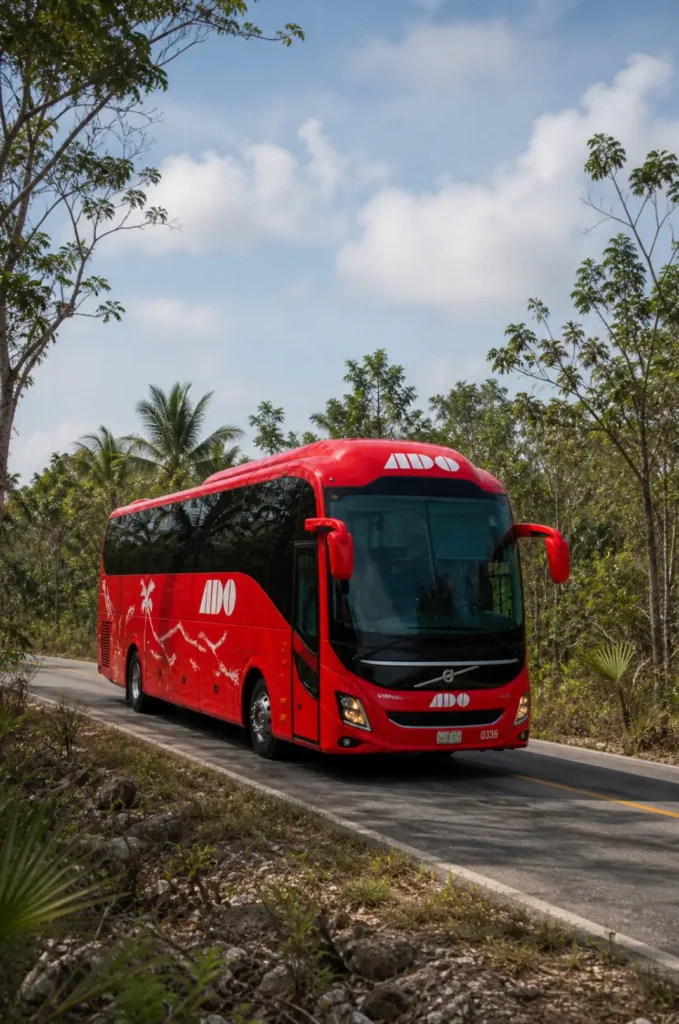
Consider that drivers at the airport may lie and tell you the bus is no longer running, could point you toward the wrong direction or will say ADO is just for locals, but that is NOT true!
The counter should be pretty easy to find. If you don’t see it, just make sure you’re asking airport staff and not some shuttle driver that may want to sell you their service.
That said, I often prefer to purchase my tickets online to skip the lines. Their main website is ado.com.mx but it’s in Spanish only. I just recently noticed there’s an “international” version in English international.ado.com.mx but I have never used it. It looks legit if you want everything in English.
For those using the Spanish site I wrote a step by step guide on exactly how to buy a ticket from the Cancun Airport to downtown using the ADO site. You can find it at the end of this guide under “resources”.
I think it’s worth mentioning that I am not affiliated with ADO in anyway and I just do this because I hate seeing people getting scammed all the time at the airport. Also, because I’ve read this kinds of articles from other people when traveling to different countries and I always find it incredibly helpful so this is kind of my way of giving back to the world.
Can I use Uber at the Cancun Aiport?
Apps like Uber do work in Cancun buy it may not work at the airport! These apps are heavily regulated and very unreliable on prime touristy arrival destinations like the airport or the bus station due to local taxi union tensions.
Additionally, I highly recommend you avoid taking a taxi from the street but if you must, confirm the price BEFORE getting in.
What’s the most affordable way to move around in Cancun?
The most affordable way to move around Cancun is to take a public bus.
The R1 or R2 buses run the entire length of the Hotel Zone and connect it to Downtown. They run from pretty early morning until late at night. The fare of these buses is $12 MXN which is about $0.65 USD.
These are great for beach hopping, getting back and forth from the Hotel Zone to Downtown and vice versa or just moving around without spending too much.
- If you’re in the Hotel Zone, all buses will take you along the strip.
- If you’re Downtown, R1 and R2 are easy to recognize because Downtown buses tend to be blue and Hotel Zone buses often red and some are orange.
Something to consider is that buses in Cancun don’t have a strict schedule so you kind of have to just stand there and wait for it. Depending on the area they may take from 5-15 mins, if you’re somewhere random in the Downtown area, far from the center, it may take like 30 mins to even an hour.
You’ll likely be in the 5 min area. Once you’ve found a stop, raise your hand to let the driver know you need to hop in (if you don’t they may just pass by because they’ll assume you’re waiting for a different bus unless they see a crowd).
Also, bus stations are not always clearly marked but this is almost never an issue specially if you’re near the main avenues. If in doubt, you can ask any local where the nearby bus stop is and they will help (If you want to practice your spanish, try to say “disculpe, donde está la parada del camión que va a la zona hotelera?” also, most people speak some level of English here so you’ll be fiiiiine).
As every other bus, R1 and R2 have a designated route so not any bus station will do. Check the routes here for R1 and here for R2. There’s also an R10 but I think it’s less frequent.
Does Uber work in Cancun?
You can use either Uber or Didi in most parts of Cancun but as I said before, in certain super-touristy areas (like the airport or near bus stations) it can get tricky.
Authorized taxi operators have a STRONG grip on arrivals and app pickups can be complicated, blocked, or may even cause an actual fight (yeah, I know, wtf).
My advice is: at the airport try ADO as I explained earlier, and at the bus station, just walk a bit out (toward Ave. Tulum) and try to take the Uber from where there aren’t so many taxis nearby. I often cross the street toward “Samborns“, where I can stand under a tree while I wait if it’s too sunny.
If you end up taking a taxi from the street it’s important that you confirm the price in advance!
Should I rent a car for my Cancun trip?
If you’re planning day trips through the Riviera Maya, renting a car can absolutely be worth it and opens up a lot of opportunities that public transport doesn’t easily reach. It’s obviously not the most cost-effective mode of transportation but it is my favorite DIY kind of trip and one of my top recommendations if you really want to go off the beaten path. Don’t if you’re just planning to stay in the Hotel Zone, though. I’ll drop some amazing day trip ideas further down on this article!
How to travel from Cancun to other destinations?
Cancun is a main gateway to the entire Riviera Maya and the Yucatan Peninsula which includes Isla Mujeres, Playa del Carmen, Akumal, Tulum, Bacalar, Merida and even Holbox. Distances are mostly short and buses are comfortable. You can also take colectivos for many of these destinations and here’s how to do it depending on where you’re going.
How to get from Cancun to Tulum?
The easiest and most comfortable way to go from Cancun to Tulum on a budget is taking an ADO bus. The buses leave every few hours and the trip takes two hours. They cost between $250-$300 MXN (~$15-17 USD), and they will leave you at the Tulum ADO bus station.
The cheapest way to get from Cancun to Tulum is by colectivos but to be honest you’ll have to take two and it’s more inconvenient than just taking the ADO. If you want to try it, first take the Playa Express explained in the Playa del Carmen section right before this one. Once you get to Playa del Carmen, you’ll have to take a second colectivo from Playa del Carmen to Tulum. They moved from where I used to take them but I found this is the location, you can also ask around once you’re dropped in Playa del Carmen. They take about 50 mins and the price should be around $55MXN ($2.99 USD) so in total, with both colectivos, the trip should cost around $100MXN ($5.5 USD) and be 2 hrs + transfer time.
Both the colectivo and the ADO bus station in Tulum are located in the center, so if you’re staying in the downtown area, you could probably walk to your accommodation from there. If you’re staying near the hotel zone or a bit further, the cab prices will unfortunately skyrocket. My advice is to try the app InDrive since Uber doesn’t work in Tulum (not a paid recommendation). It’s like an Uber but you kind of choose what you’re willing to pay in advance. It may take bit to grab one but it’s the only app that worked for me in Tulum when I stayed for a month there in June 2025.
How to get from Cancun to Playa del Carmen?

The most comfortable way to go from Cancun to Playa del Carmen on a budget is to take an ADO bus from the Cancun Centro bus station or Airport ADO terminal. Buses leave every 30-40 mins from 6 am to midnight and will drop you right at Playa del Carmen’s heart. The price of the ADO bus is about $130-$150 MXN (~ $8-9 USD)
Playa del Carmen has two stations: “Alterna” and “Turistica” both are in strategic areas that are easy to navigate so just choose one depending on which is closer to your accommodation. The distance between Cancun and Playa is ~68km (~42 miles) and it takes about 1 hour and 30 mins to get there by bus.
The fastest and cheapest way to go from Cancun to Playa del Carmen is to take a Colectivo. These are shared vans that you can take from Ave Tulum (right infront of the ADO station). They leave when full and cost around $45MXN (~$2.45 USD). The company is called “Playa Express” and they’re small but comfortable enough, with A/C. In my opinion, they drive a bit too crazy so I often opt for the ADO even if it puts me back about half an hour. It takes about 1 hr to 45 mins to get to Playa by Colectivo and the wait period is often less than 10 mins.
PS. Colectivos stop midway in Puerto Morelos so you can also use this transportation method if you’re planing to go there.
How to get from Cancun to Isla Mujeres?
To get to Isla Mujeres from Cancun the first thing you need to do is get to the Ultramar Ferry. If you’re staying in Downtown Cancun, go to the Puerto Juarez Ultramar port by Uber or Didi (10 mins from ADO bus station). It runs every 30 mins until 2:00 p.m. and then every hour. The ferry only takes 20 mins to get to Isla Mujeres and it costs $290MXN ($16 USD) one way and $580MXN ($31.50 USD) round trip. You can just buy the round trip ticket and save it for later since they’re not marked with a specific time).
If you’re in the Hotel Zone there’s also an Ultramar port in Playa Tortugas and another one in Playa Caracol but these go way less often.
You can check the ferry schedule here for all their routes.
PS. Once in the Island, rent a golf cart only if you plan to explore the north to south route and consider that part of the experience. I love it but It’s not a requirement especially if you’re just planning to stay near Playa Norte. More on this later.
Best season to visit Cancun and when to avoid visiting
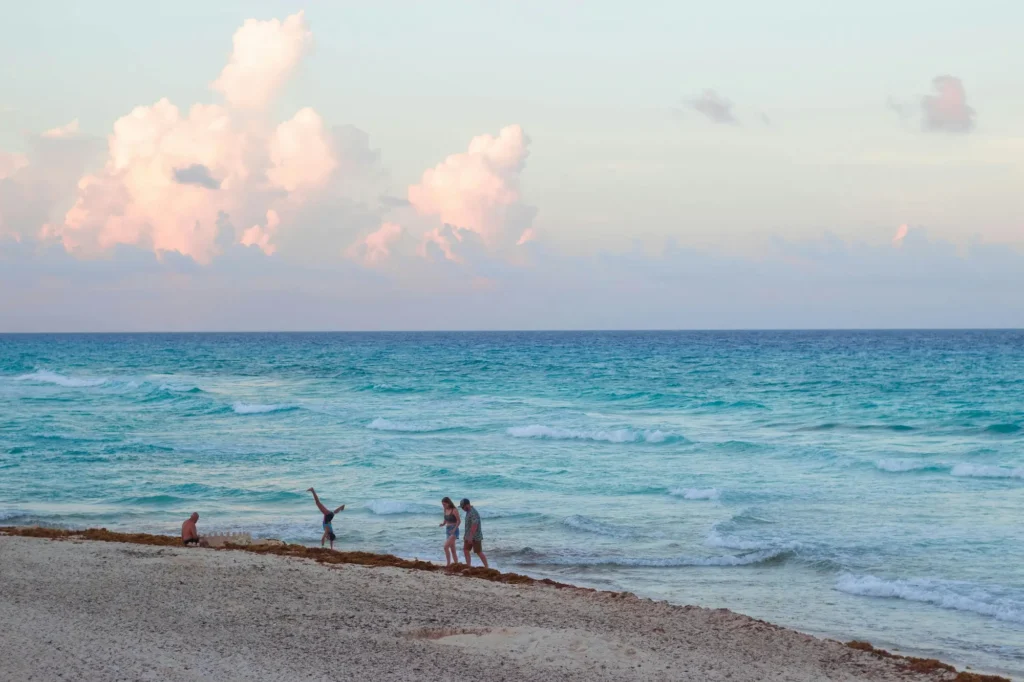
Avoid April through August if the beach is important to you. This is sargassum season, the period when large mats of brown seaweed wash onto the Caribbean facing beaches along the Riviera Maya. Some years are worse than others but in bad years the smell is strong and the water looks nothing like in the photos (in depth info about this below).
The best months for clean water are November through March. It’s still warm, the seaweed is minimal, and you’re outside of both hurricane season and the spring break surge. December and January are my favorite months, with slightly cooler evenings but days are still beautiful and warm.
If your dates fall in seaweed season and you can’t change them, visit more Cenotes instead and spend more time in Isla Mujeres (the island is always clean of sargassum just consider it gets super packed because of this so go to the beach early in the morning)
The seaweed issue: what is it and how to avoid it?
Growing up in Cancun, I remember having the privilege of jumping in the turquoise water with clean white sand literally whenever throughout the year. Now this is no longer possible ☹️ let’s talk about Sargassum.
What is sargassum?
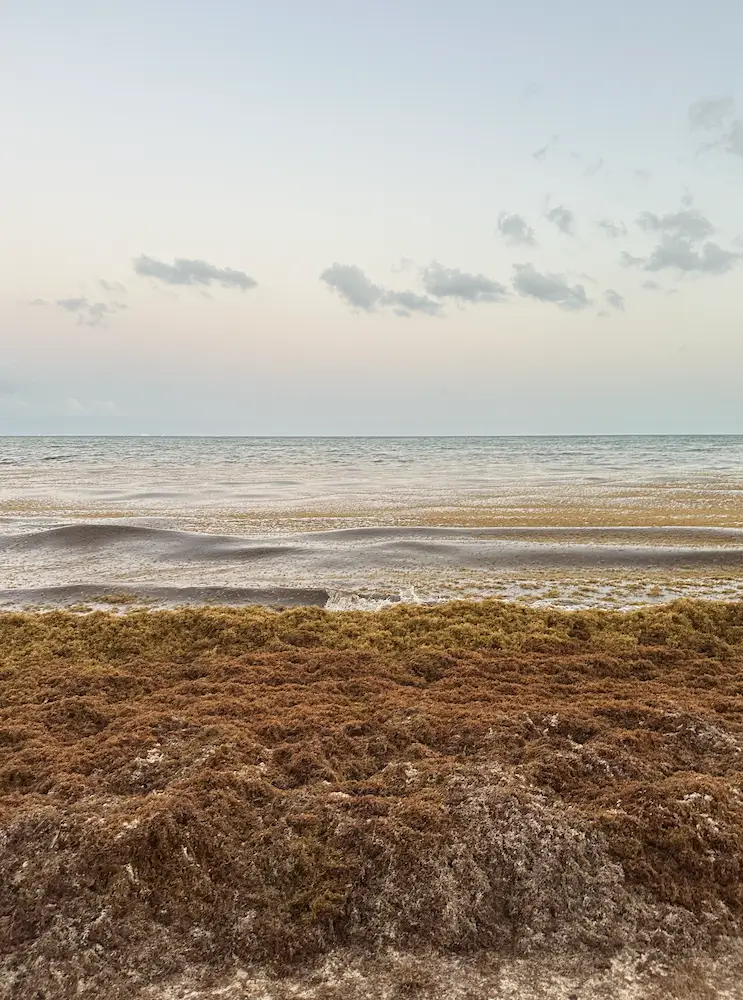
Sargassum is a brown type of seaweed that floats in the ocean. In small amounts is harmless, the problem happens when it arrives on shore in industrial quantities. It piles up on the sand, it rots and releases a gas that smells horrible, it makes the water murky and totally uninviting and it’s not recommended to swim on it at all.
Before 2011 significant arrivals of seaweed on the Caribbean were rare, it largely stayed out in the open Atlantic. Ever since, unfortunately, the trend has been more and more sargassum every year. According to my research the reason for this to happen is hard to define. There’ a combination of global and local factors that have contributed to the issue and some of them are directly connected to poor decisions made right here, in the Yucatan Peninsula.
At the global level, climate change, deforestation (specifically in the Amazon) and nutrient pollution are the primary reasons along with rising ocean temperatures. The heat and runoff that pollutes the water with nutrients stimulate seaweed growth at alarming rates, then its carried over through the Atlantic all the way to the Caribbean through ocean patterns that add complexity to the issue.
At the local level, there’s a conversation that doesn’t get enough airtime imo. The role of large-scale development of the Peninsula itself (which contains Cancun, Playa del Carmen, Tulum, the Riviera Maya and other of your favorite Mexican Caribbean destinations) and specifically, all of what’s been destroyed to build the version of it you see today.
The mangroves
Mangroves are basically the Peninsula’s lungs. Before the Hotel Zone even existed, the coastline of Quintana Roo was lined with them. These are dense, root ecosystems that filter coastal water, stabilize shorelines and basically keep sea temperatures low. They’re also crucial for fish and marine life that feeds the reef system. The mangroves in Quintana Roo are being lost at a rate of 150,000 hectares a year.
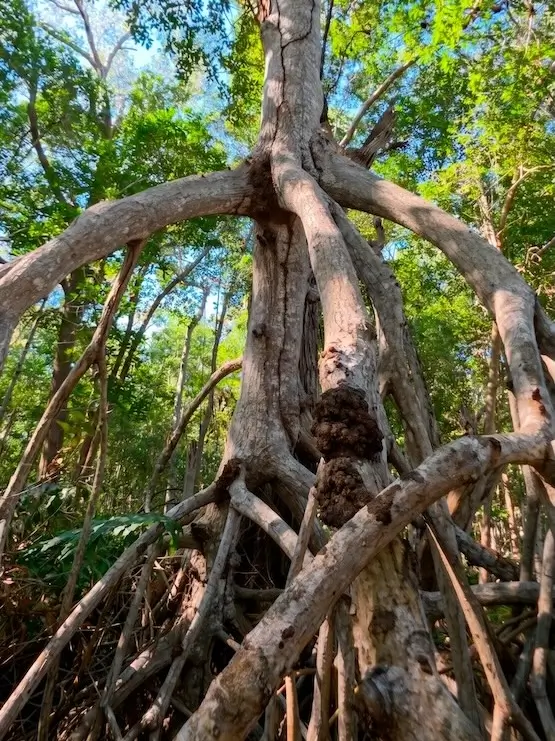
The consequences are very clear and visible for the locals like me that have seen the city grow with so much lack of thought, care, and proper planning. Without the filtering and thermoregulation of the mangroves, the water becomes a paradise for seaweed to grow exponentially (and becomes a hurricane magnet but that’s a different conversation). The natural buffer that prevented these issues from hitting our coasts has been transformed into resorts, apartments, parks and malls. Not to mention the pollution from hotels dumping wastewater discharges from tourism-related activities into mangroves.
The increased loss of mangroves due to resort development is an environmental tragedy.
It’s ironic that the same infrastructure that profits from the Mexican Caribbean has been the one to remove the system that maintained it. It’s clearly the accumulated cost of decades of irresponsible environmental decisions made in the name of progress.
Speaking of, right now, as I write this text, there is a massive project set to construct a 90-hectare water park on a protected mangrove area, an essential natural barrier for marine life and ecological balance of the Caribbean. As a local, and someone that cares about the environment,I find this outrageous and if you do too, please sign this change.org petition, it takes a minute and with a big crowd it can make a difference. In México we would call this “poner tu granito de arena” which means “do you bit”, but literally translates to “leave your grain of sand”. The Caribbean is everyone’s even if you live far away. So, thank you for leaving your grain of sand in the Caribbean, let’s make sure you can still find it when you come back 🩵.
How to avoid seaweed in the Riviera Maya?
Authorities and hotels try to clean the main public beaches regularly but it’s an unpredictable situation. As I mentioned before there is a best time to come which is November through March and you can track beach conditions through several sources:
- Sargassum Monitoring Facebook groups for real-time photos and reports which I found more reliable than any official forecast, but the specific beach you’re looking for may not be there right at the time of your visit.
- The “Secretaría de Ecología y Medio Ambiente de Quintana Roo or SEMA” social media, which is a governmental institution that regularly posts “seaweed maps“.
- Sargazo.info it has a list of the main beaches around Cancun – Tulum coast and a blue or green indicator means little to no sargassum.
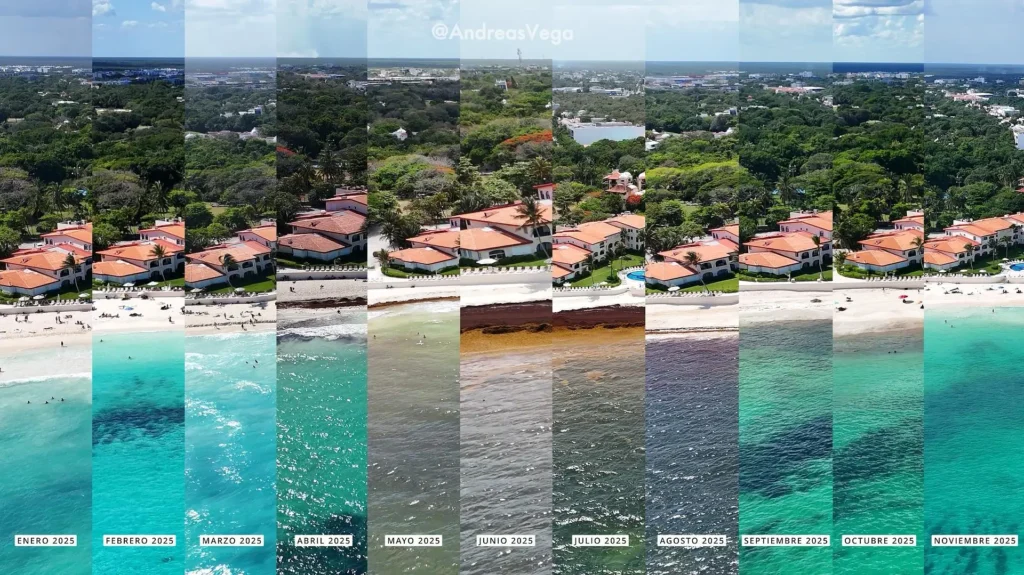
The photo above was taken with a drone in Playa del Carmen. Keep in mind that this is one beach and it may not reflect the entire Riviera Maya situation but it’s a good way to visualize the issue and how it changes throughout the year.
Where to stay in Cancun? (Smartest choices for travelers)
So we talked about the difference between Hotel Zone and Downtown before. Let’s break them down a bit more so you can decide which one is best for your trip.
The Hotel Zone vs Downtown Cancun for Budget Accommodation
For most budget travelers, Downtown is the right call. Accommodation is significantly cheaper than anything comparable in the Hotel Zone, you’re surrounded by actual food options at real prices, and the public buses to the beaches run frequently enough. Downtown also puts you closer to the ADO terminal which matters if you’re using Cancun as a base to move around or do day trips to Playa del Carmen, Tulum, Merida, etc.
Staying Downtown means you’re in a regular working Mexican city. It’s noisier, way less polished, and requires a bit more navigation.
That said, the Hotel Zone isn’t automatically off the table even on a budget. If you’re only in Cancun for just a couple of days and your priority is maximizing beach time, staying in the Hotel Zone makes sense. You can potentially find budget hotels or hostels (Mayan Monkey, Hotel Zone Selina, Natura) offering rates competitive enough with Downtown once you factor in transportation cost and time. Keep in mind these places tend to cater a young party-oriented crowd if that’s what you’re up for. Also, eating out in the Hotel Zone can be more expensive so it’s worth comparing both options before you decide.
So, basically:
- For a beach focused short trip – Hotel Zone
- For a longer stay, connection to other cities or tight budget – Downtown
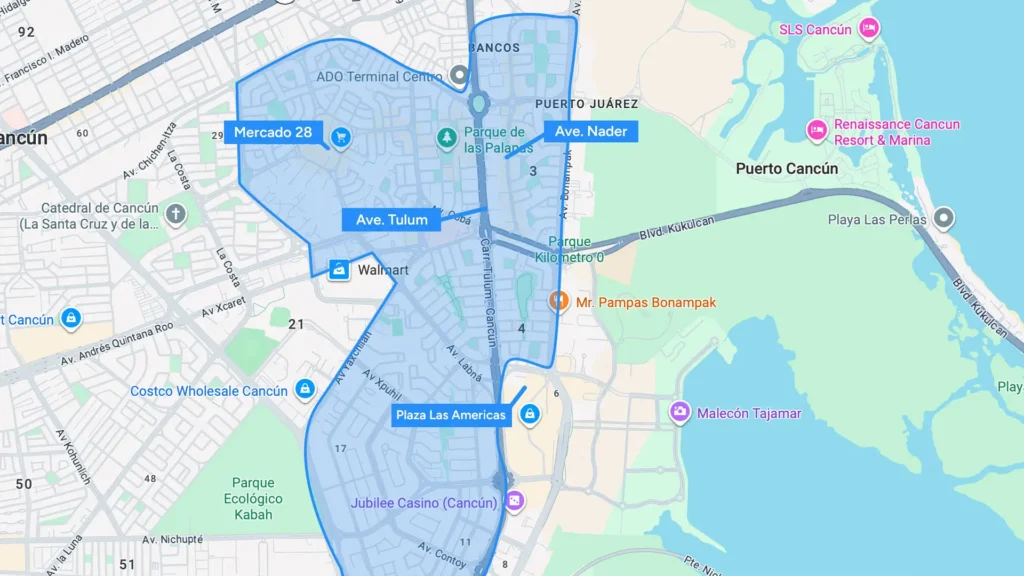
Neighborhood breakdown of Downtown Cancun
If you’re staying in Downtown Cancun you don’t want to be in a residential area, some neighborhoods are too far from anything worth seeing so you should consider well connected neighborhoods like the following ones. Some are nicer than others but all of them are easy to navigate.
Ave. Carlos Nader (SM 3)
When looking for accommodation in Cancun Downtown area my #1 advice would be the southern side of the Ave. Carlos Nader.
This avenue is a short stripe of little cafés, restaurants and bars. It’s small, not very crowded and it’s generally safe since it’s right behind the “city hall” or “ayuntamiento“. It’s also super close to one of the most important Avenues in Cancun (Ave Tulum), it’s walking distance from the ADO, most accommodations are sort of tucked in rather than next to the main street and it’s just a nicer neighborhood in comparison to the rest that are in the “well connected” zone.
For digital nomads or solo travelers “La Nader” has the perfect balance: central but not chaotic and it’s surrounded by everything you may need.
Near or around Ave. Tulum
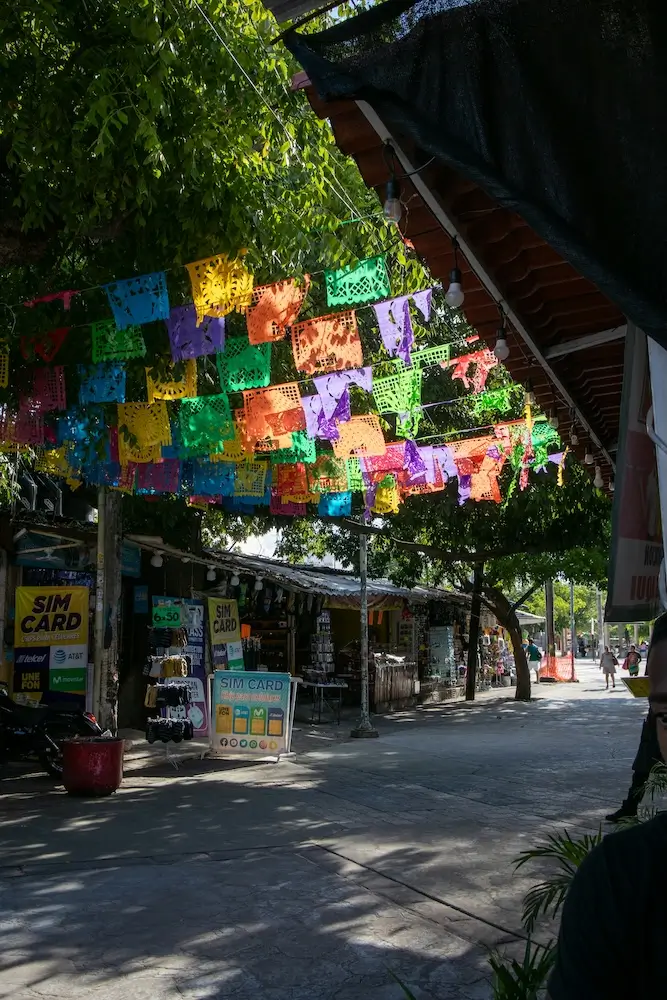
Avenida Tulum is Cancun’s main artery. You’ll be extra connected from here to buses, colectivos, street food, and daily life.
Staying near Av. Tulum is great for transportation, it’s a long avenue so make sure to look for something on the side streets that sort of branch off of it for a more peaceful stay since it can be crowded there. Choose an area between “Plaza las Americas Cancun” and “Parque de las Palapas”, shown in the map above.
Somewhere around Mercado 28
Mercado 28 is a halfway tourist trap and halfway local hub, you can easily identify it on a map because it’s supposed to look like a flower from an aerial view. Yep that’s the only reason that section of the city was designed that way lol.
The surrounding streets have plenty of affordable guesthouses and Airbnbs making it a very convenient base. It’s not as polished as Carlos Nader but it’s practical. You’ll have quick access to restaurants, supermarkets, and bus routes.
Huayacan and Ave 135
These are not marked in the map above since they’re far from everything. I would recommend this area only if you need to be near the airport for some specific reason (early flight or business). These are newer residential zones in Cancun with modern apartments, some local cafés, gyms, restaurants, etc. Although, if you’re going to the airport by ADO, then just stick to Ave Tulum instead since these are far from downtown.
Neighborhoods to avoid
A good rule of thumb is to skip anywhere between “Ave Lopez Portillo” and “Arco Norte”. Especially if you don’t speak Spanish.
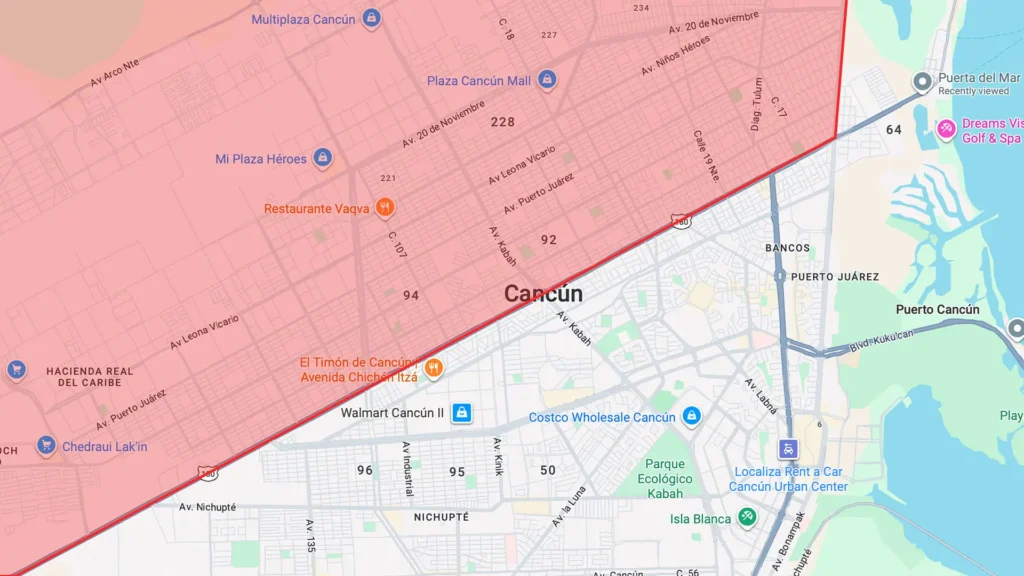
These are residential areas with nothing touristy to do, and while most of Cancun is safe with normal precautions, these areas can range from just sketchy to quite dangerous the further you go into Arco Norte.
You’ll also want to skip Bonfil, a semi-rural neighborhood near the airport. It can get pretty dangerous at night and even locals go there with precautions so it’s better to avoid it all together.
Best beaches to visit in Cancun IMO
Cancun’s beaches are famous for a reason. The sand really is that white and the Caribbean really is that turquoise. Growing up here, beach days would never be about paying for a beach club or a fancy hotel. For my friends and I, beach days were just about showing up with a towel, beer and (hopefully) sunscreen.
Every beach in Mexico is public by law, including the ones that have a resort sitting on them. The hotel’s sun loungers and umbrellas are off limits, but the sand and the water? You’re free to lay or swim anywhere!
The list below covers the beaches I’d recommend, public access, amenity info and the ones worth going out of your way for.
A few things worth noting:
Bring your own everything. Most of the best public beaches have little to no vendors. Pack water, snacks and your own shade if you need it. You can stop by an Oxxo or GoMart before getting to the beach to purchase chips, beer, snacks, etc (keep in mind glass is forbidden at the beach, so bring cans!)
For seaweed season info please check the “Best season to visit” section above.
Playa Delfines
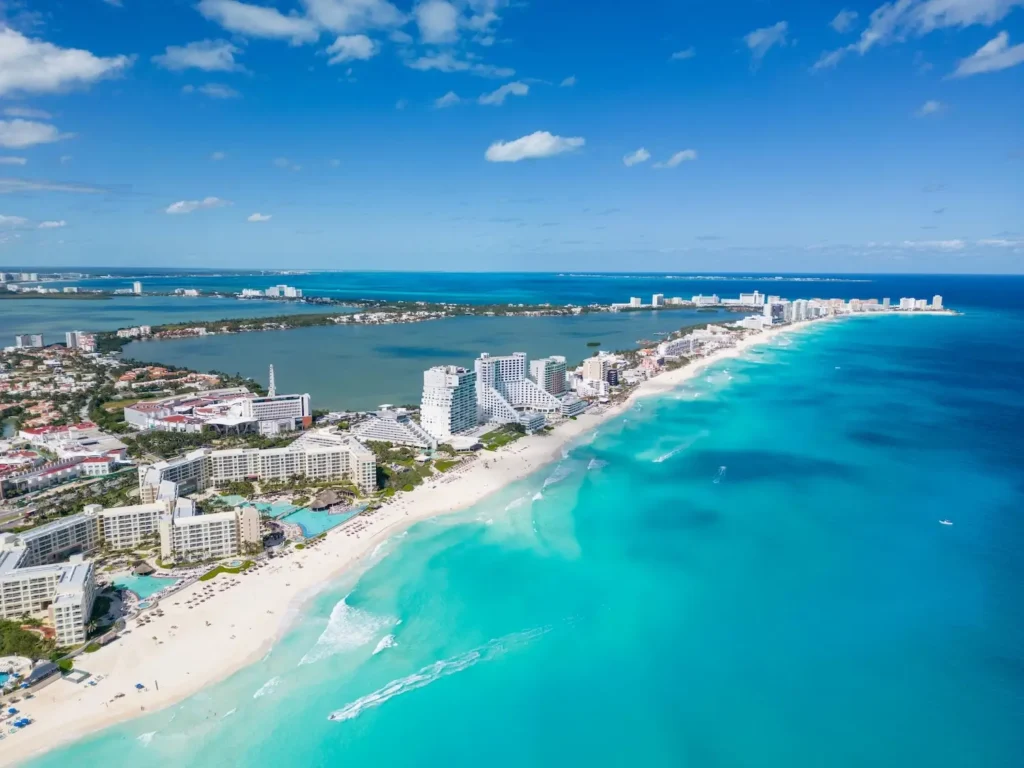
Playa Delfines is the classic local favorite, here’s where my dad would always detour after picking up a friend or a family member from the airport to show them the beautiful view and tease them a bit to later come back fully prepared for a relaxing beach day. Delfines is a wide, open beach with lifeguards, bathroom and free palapas. Sometimes the waves may be high and a bit intense so this is not always the beach for swimming but it’s still worth a stop. If you have just one day to go to the beach, go to this one.
Playa San Miguelito
Playa San Miguelito in Cancun used to be a local hidden gem that became a bit more mainstream over the years, but it’s still a solid option and a local favorite. Consider there are no palapas, no vendors, no amenities, just you, the sand and the ocean. You can combine it with a visit to the Museo Maya if you’re interested in checking that out.
Playa Forum
Playa Forum is the most touristy of them all, therefore, it tends to be crowded specially if you visit on a weekend. Here’s where you’ll find some of the most famous beach clubs like Mandala Beach and the Coco Bongo Beach Club. You can either visit them, just stay nearby to enjoy the music and be surrounded by the party crowd, or as I often do, you can walk far from it and sit near the wave breaker. Most people don’t walk there and just stay near the entry so it tends to have more open space.
Most famous beaches in Cancun – comparison table
| Beach | Location | Description | Amenities | Best for |
|---|---|---|---|---|
♥ Playa DelfinesLocal favorite |
Km 18, Hotel Zone Google Maps ↗ |
The only resort-free stretch in the Hotel Zone. Wide open sand, strong waves, and the iconic “CANCÚN” sign. |
|
Locals, sunbathers, photographers |
♥ Playa San MiguelitoHidden gem |
Km 16.5, Hotel Zone near Museo Maya de Cancún Google Maps ↗ |
Same powder sand as Delfines with a fraction of the visitors. Pristine and bare — bring everything you need. |
|
Couples, museum visitors, locals |
Playa ForumMost touristy |
Km 9.5, Hotel Zone near Forum by The Sea Google Maps ↗ |
The most touristy one near Mandala beach and Coco Bongo Beach Club, there’s music, it’s crowded, and it’s practical. |
|
Party seekers |
Playa CaracolCalm waters |
Km 8.5, Hotel Zone near ferry dock Google Maps ↗ |
Small, calm and gentle waters, often crowded, close to the Isla Mujeres ferry. |
|
Swimmers, locals, day-trippers |
Playa LangostaFamily-friendly |
Km 5, Hotel Zone Google Maps ↗ |
Shallow, warm, and wave-free. One of the most convenient public beaches for families, kinda crowded. |
|
Families, young kids, day-trippers |
Playa Pez VoladorLocal pick |
Km 5, Hotel Zone next to Playa Langosta Google Maps ↗ |
Right next to Langosta — walk right past the rocks and you’ll find quieter, less crowded spots. My go-to for a quick beach day after work. |
|
Locals, day-trippers |
Isla BlancaOff the map |
~23 km north of downtown Cancún Google Maps ↗ |
Last time I went it was an untouched sandbank peninsula — Caribbean one side, lagoon the other. I’ve heard it’s changed a bit but still worth it if you’re up for the adventure. Zero facilities; bring everything. |
|
Nature lovers |
Playa TortugasFamily-friendly |
Km 6.5, Hotel Zone Google Maps ↗ |
Lively beach with water sports, seafood, and bungee jumping. Departure point for Isla Mujeres ferries. Very crowded. |
|
Travelers, Isla Mujeres day-trippers |
Playa AnchaCalm waters |
Km 9, heart of Hotel Zone Google Maps ↗ |
Quiet pocket beach, rarely crowded. No direct public access — walk in from Playa Caracol or Tortugas. |
|
Couples, those wanting quiet in the zone |
What to do in Cancun (Beyond the resorts)
Most travel guides will tell you to stay in your resort, book a tour to Chichen Itza and eat at a restaurant with views to the lagoon. That’s great, but if you want to know what people from here actually do on a day off, well, it looks a little different.
In the city
Cultural events
The Instituto de Cultura y las Artes has gotten significantly better in recent years about actually programming things worth going to. A few months back they organized a full theater season that ran for several weeks (proper productions targetted to locals) They’ve also put together community-oriented events around holidays and festive days like Dia de Muertos, Independence Day, New Year’s, etc. Follow their social media or ask locally what’s coming up – programming changes frequently and it isn’t always well advertise outside of Facebook and local community pages.
Sunrise Kayak
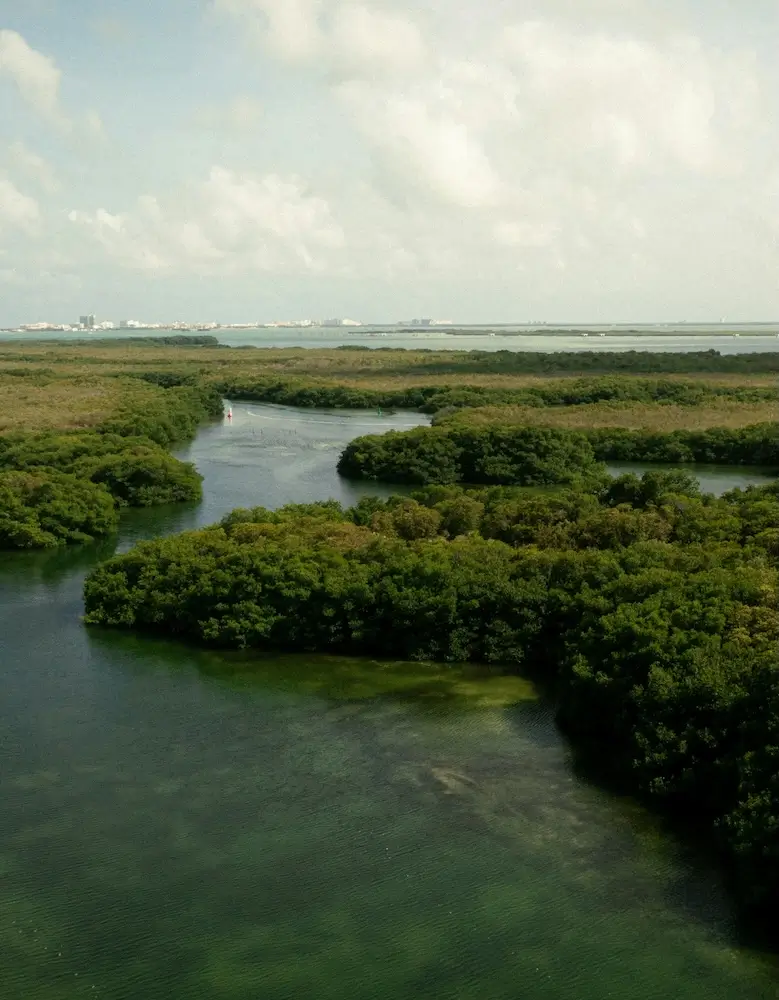
Laguna Nichupté runs along the entire Hotel Zone and is genuinely beautiful at dawn. There are local groups who organize early morning kayak sessions on the lagoon (you can research on Facebook groups or Airbnb experiences). Paddling at sunrise is a truly beautiful experience that most tourists never find. That said, one very important note: do not swim in the lagoon. Not even if you see locals doing it. The lagoon has crocodiles 🐊 so stick to a kayak, keep your hand in the boat, preferably go with a local group and enjoy the view from a distance.
Parque Kabah
This one is for the long-term visitor who needs a run. If you’re in Cancun for more than a quick beat (like working remotely, slow traveling, or just staying longer than the average tourist) You may like checkin out Parque Kabah. It’s one of Cancun’s larger green spaces (not even that big tbh) with trails through a jungly vegetation. Just make sure to go early. By 9am the heat and humidity start intensifying, by midday it’s brutal.
Parque Cancun
Parque Cancun is honestly a new one that I haven’t visited myself yet but it’s also a space for recreation a bit further out from the city center. My advice would be the same, go early since mid day in Cancun is truly not the time to be wandering around in a park.
Malecón Tajamar
The Malecón is a waterfront promenade along the lagoon. On weekends, there’s sometimes something going on (small art fairs, community events, live music) but it’s inconsistent. You can check local Cancun Facebook pages to know if there’s anything happening that day. If not, it’s a pleasant stroll but, in my opinion, not worth rearranging your day for. There’s not much shade so do it closer to sunset time!
El Meco Ruins
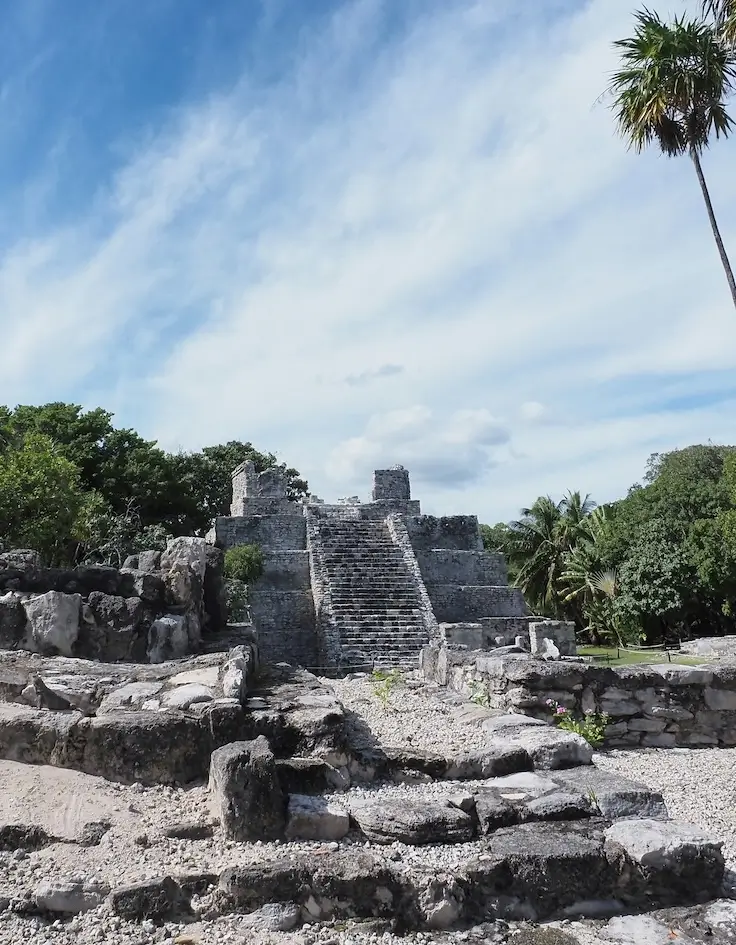
On the new Hotel Zone, on the road toward Punta Sam, sits El Meco. A small archaeological site that almost nobody visits. The main pyramid is called El Castillo and it’s pretty cool to check out if you’re up for a detour. The visit is super quick and some archaeologists believe it was one of the most important settlements on the northeastern Yucatan coast before the Spanish arrived. It served as a key port for trade with Isla Mujeres and Coba. It won’t take more than an hour to walk through, the entrance is super affordable and you’ll likely have the place to yourself. It’s not Chichen Itza, but hey, it’s a super easy stop if it happens to be on your way.
Try a Marquesita or a Esquite
The marquesita is a thin, crispy Yucatecan type of crepe rolled and filled with your spread of choice. The esquite is a cup of warm corn kernels topped with lime, salt, chili, and mayonnaise. It’s one of Mexico’s most beloved street foods. In Cancun, a good local spot for both would be Parque de las Palapas in downtown especially on weekend evenings.
The park itself is nothing fancy. It’s a simple open-air plaza (not very much park-like since there are barely trees around) where families bring their kids to play around and vendors stand near their carts selling snacks.
Parque de las Palapas is just a place where people hang out. Check it out on a weekend evening where it’s most alive, there may be live music or some show. Fyi weekdays are noticeably quieter and a bit flat.
Day Trips from Cancun
People come to Cancun expecting the destination to be Cancun. Honestly, the city itself is mostly beaches and resort infrastructure but what I actually like from being here is how well-positioned it is as a base. Within a couple of hours in any direction you have some of the most extraordinary places in Mexico. Which means the smart move is to use Cancun as a launching pad rather than your whole trip.
Guided Tours Recommendations
Here’s is my personal selection of 3 guided activities (use my code DANIEYANEZ5 for a discount on these or any GetYourGuide activity)
Isla Mujeres
A 20-minute ferry ride from Puerto Juarez (the local option) or Playa Tortugas (in the Hotel Zone) gets you to one of the most charming spots in the whole Riviera Maya.
Isla Mujeres is a small island (about 8km long, ~4.98 miles) and the best way to explore it imo is to rent a golf cart and drive around the island, you can find several spots near the ferry dock. If you do, stop a minute by Punta Sur, ideally in the early morning. Punta Sur is the southern tip of the island where the Caribbean opens up fully and the cliffs drop into agitated deep blue water. The views from here are amazing and I think the drive is totally worth the effort.
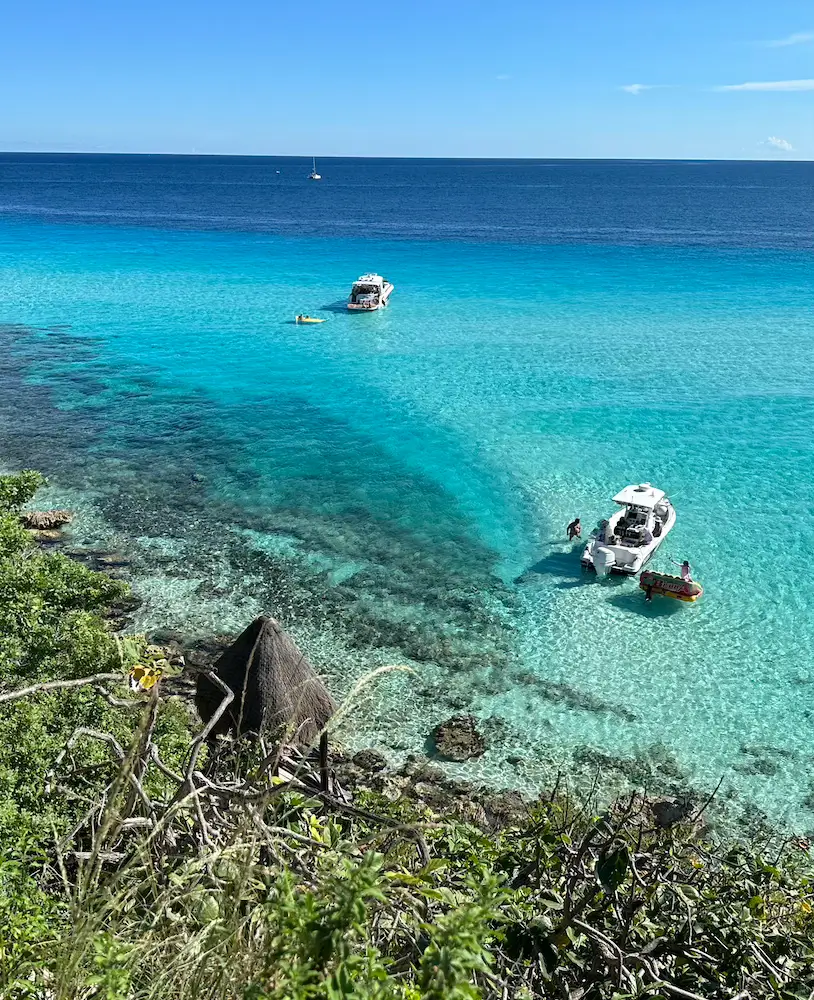
You can also check Playa Norte but keep in mind this is not the beach for you if you’re looking for a remote space just for yourself. Go in the morning, it will be your best bet at skipping the crowds but you’ll see Playa Norte gets busy FAST.
My favorite time to be here is actually around sunset, be aware that restaurants and bars start closing up around 5 p.m., so when I go, I just sit in the sand or go for a swim with the beautiful scenery. I tend to skip Playa Norte from like 11 am to around 4 pm. This is the sunniest and most crowded part of the day. The water in Playa Norte is absurdly calm, the color shifts from pale turquoise to deep teal depending on the light and the whole atmosphere is tropical and chill in a way Cancun’s Hotel Zone could neveeer.
The once-in-a-lifetime experience to do in Isla Mujeres is swimming with the Whale Shark. This is hands down one of the most incredible things I’ve seen in my life. I may write a full article about this one day but until then, please make sure to do your research about the best practices and be a responsible traveler if you decide to do this. Look for a legit company that will follow the procedures to protect these amazing beings.
La Ruta de los Cenotes
South of Puerto Morelos, running inland from the highway is what we call la Ruta de los Cenotes (the Cenotes Route).
This “route” it’s a stretch of road lined with cenote, after cenote, after cenote. Most of them are small-scale, not touristy and EXTRAORDINARYY. This is my top recommendation for anyone staying more than a couple days near Cancun and is legit looking to explore off the beaten path.
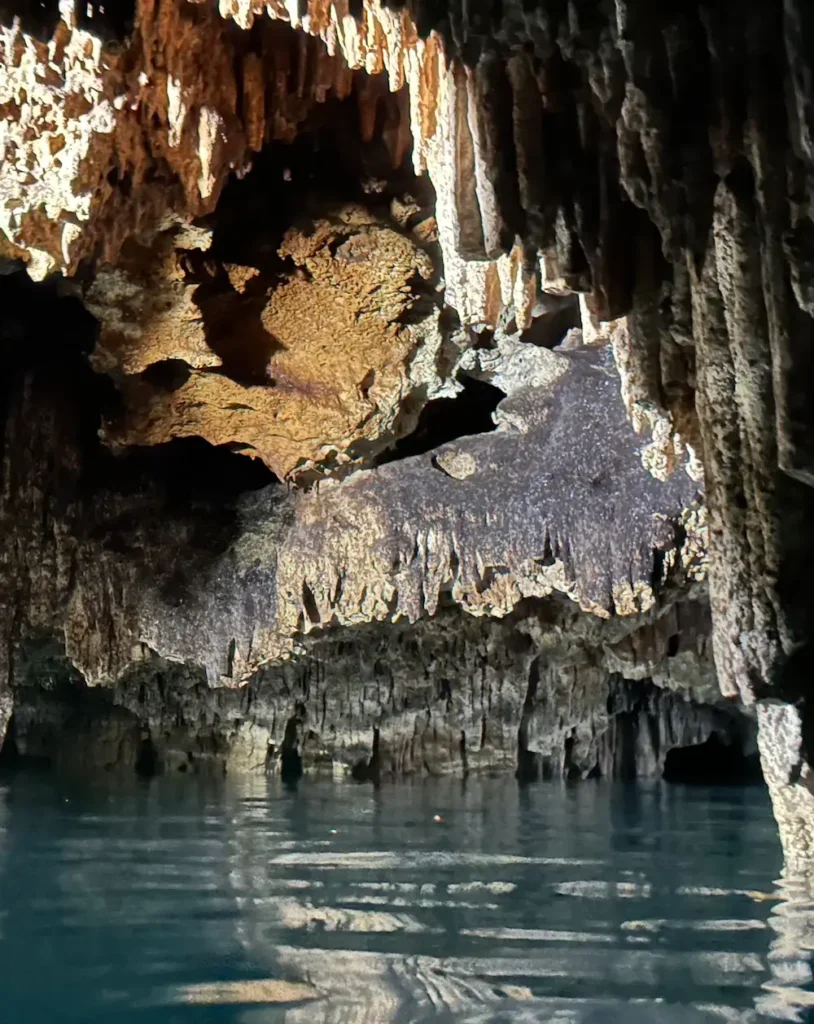
There is a catch though: you’ll most likely need to rent a car. Tours to cenotes do exist but they tend to take you to the same two or three, keep you on a schedule and add a significant, significant markup. With a car, you can freely drive the route at your own pace, stop wherever looks interesting, pay the small entrance fee directly and spend as long as you want floating in water so clear its unreal.
Some cenotes along this route are open-air while others are partially or even fully underground caverns where you swim through chambers with light filtering through cracks in the rock. These are a few non touristy recommendations: Cenote Siete Bocas and Cenote Verde Lucero. Or explore on your own, start here, drive inland through the ave “Leona Vicario”
Snorkel in Puerto Morelos
About 30 mins south of Cancun, sits Puerto Morelos, a small fishing town that somehow hasn’t been entirely swallowed by the resort development surrounding it on both sides. It’s quiet, a little sleepy, and genuinely lovely. This is the kind of place where fishermen still bring their catch in the morning and the main square has some trees, chairs, a church and not much else is going on.
The main reason to visit would be the reef. Puerto Morelos sits in front of one of the biggest coral reef systems in the world. Some people actually snorkel from the beach but you can book a short boat trip from one of the local operators on the dock. You’re likely to see a variety of colorful fish, sea turtles, rays and coral formations.
Xcaret (specifically the night show)
Xcaret is a large eco-park about an hour south of Cancun, and yes, while it is, in fact, a theme park, it’s an experience I would always recommend. Especially if you’re not seeing much more of Mexico during your trip. Consider that Cancun is arguably the least culturally Mexican city in the whole country (sorry! lol) so the night show: Xcaret Mexico Espectacular is a MUST, it gives you a compressed but real window into how culturally diverse Mexico is. It’s an elaborate performance that covers Mexican history, regional dances, music and traditions from across the country. It’s staged across multiple acts with hundreds of performers, elaborate traditional clothing, and production values that are genuinely impressive. Totally worth it for that alone and you can just enjoy the park during the day. You can check their website for options (this is a not affiliated recommendation).
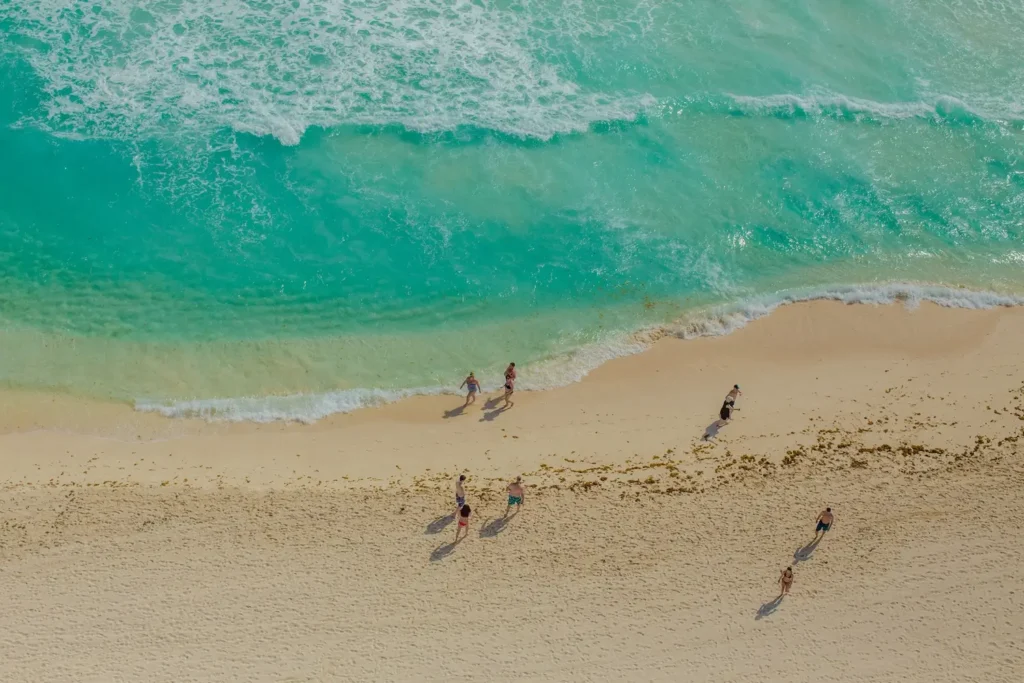
Safety in Cancun: Tips from a Local
Most of Cancun is generally safe for travelers and digital nomads, so most travelers won’t experience any issues. How safe you feel can depend on where you stay, how you move around, and how aware you are of your surroundings. Also, whenever you travel make sure to be aware of where the nearest hospital is, emergency phone numbers, police, etc.
Get a Cancun Emergency PDF
I put together a free one-page PDF with emergency numbers and addresses, hospitals, pharmacies, key safety tips, and even info in case of a hurricane. Drop your email below and I’ll send it straight to your inbox.
Common concerns in Cancun
I won’t deny crime does happen, though it’s mostly concentrated in specific areas of the city that tourists have no reason to visit (refer to the neighborhood section for more info about areas to avoid). If you’re staying downtown or in the hotel zone, moving around during normal hours, your risk profile is not different from any other large city. I actually wrote an in depth article on this topic.
That said, here’s what’s worth watching out for:
Petty theft – Pickpocketing, bag snatching, and opportunistic theft happen particularly in crowded areas, like the bus station or the beach if you leave your stuff unattended. Don’t leave your phone face-up on an outdoor restaurant table, don’t bring valuables to the beach unless someone is watching them… basically don’t leave your stuff unattended in general. It’s also worth noting that you may want to hold your phone a little tighter when walking in the street.
Taxi scams – As mentioned above in the transport section, the airport situation is the most likely place you will get overcharged. In general, when using a taxi, agree on price before you hop in and don’t accept rides from people who approach you in the arrival halls unless they’re driving a clearly marked taxi (white with a green stripe) and wearing a uniform (white with a green logo).
Drink spiking – The nightclub zone has a well documented history of drink spiking. To be safe don’t accept drinks from strangers, go with people you know, keep an eye on your glass, and as my dad always said, never accept a drink that hasn’t been opened in front of you. Unfortunately, I wouldn’t trust waiters in nightclubs either, so this rule would often default me to beer. You could also consider buying a bottle if you’re with a group.
In summary, use the same judgment you’d use anywhere else: be aware of your surroundings, don’t flash expensive items, don’t wanter into unfamiliar neighborhoods alone at 3am and you’ll be fine.
Other notes:
Water – Don’t drink tap water anywhere in Mexico. This applies to locals too! Bottled water is cheap and available everywhere. By the way, if you order a glass of water in a restaurant, they will never give you tap water. Maybe, if you’re somewhere sketchy, but it’s highly unlikely.
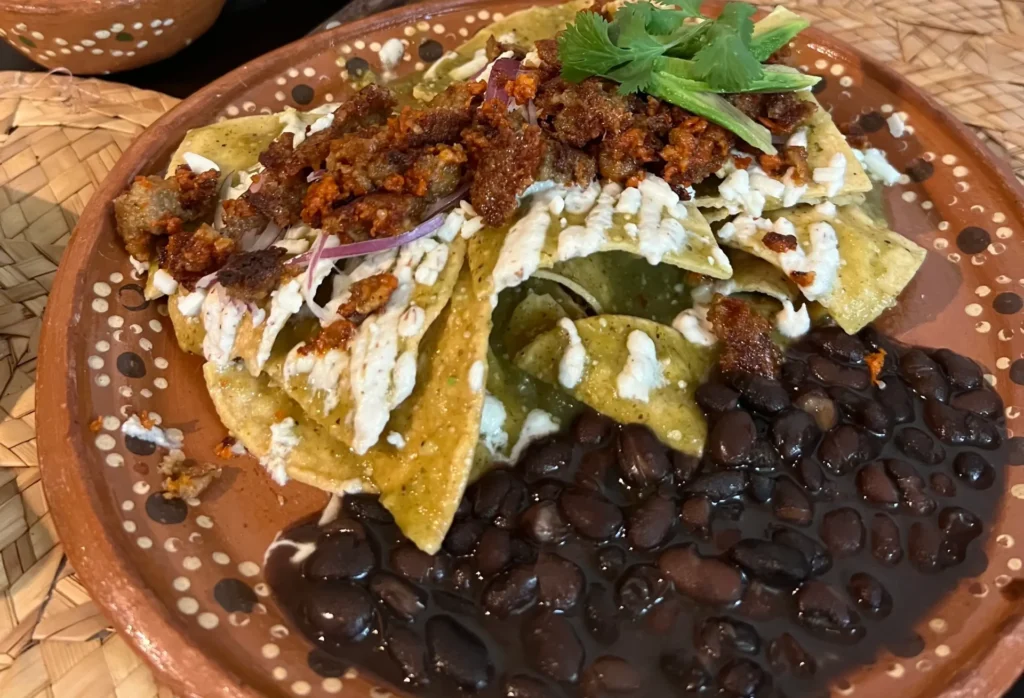
Where to eat plant-based in Cancun
To be honest, while you can get good mexican food in Cancun, this city is not a particularly interesting destination for it. If you’re traveling to Mexico for the food, I can highly recommend you to visit Merida, Oaxaca or Puebla to start. That said, you can definitely find some great foodie spots in Cancun.
Something to consider is that I will not recommend restaurants that I wouldn’t personally support, so all the spots I mention have solid vegan and vegetarian options or are fully plant-based and I have tried and liked something there. If you eat everything, you’ll find great options for you in these places too, so here’s my ultimate list of all the vegan friendly places in downtown Cancun.
Restaurants with good vegan options in Cancun
Finding vegan options in Cancun is hard but not impossible, these are my favorite vegan options in the Cancun center. It’s worth to mention that I’m not affiliated with any of these in anyway and I’ll just drop the google maps link for you to check them out.
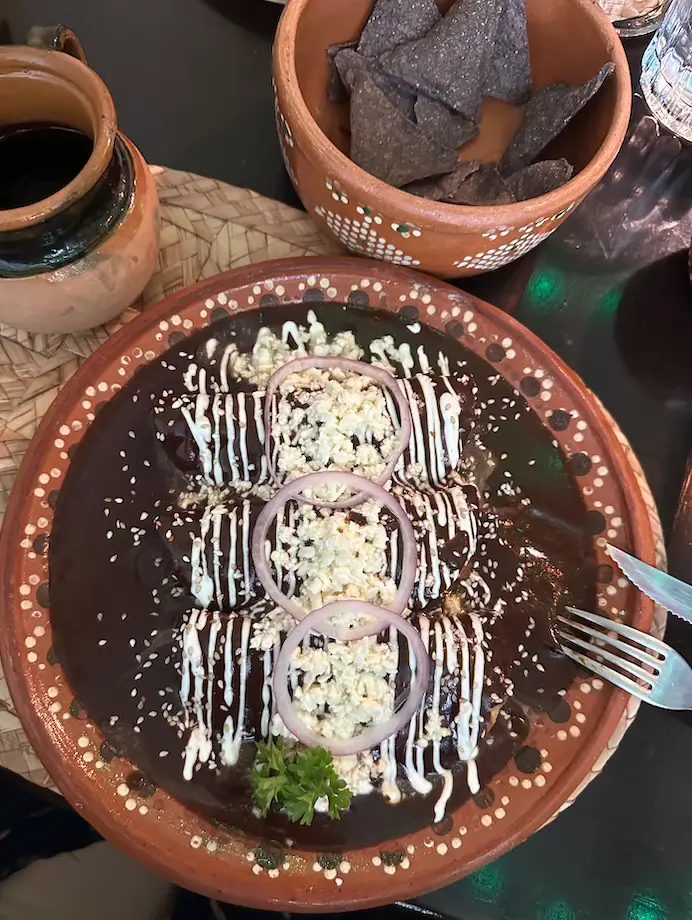
- La Casa de las Mayoras: My personal favorite for mexican food. This restaurant is not fully vegan but they have plenty great options. It’s a locally owned cute little house adapted into a cozy restaurant that serves traditional food and their plant based versions. I absolutely recommend it, it’s a total hidden gem. Try their enmoladas de yaca or quesadillas de “vegan tinga”!
- Tomizen Ramen: My absolute favorite ramen place with vegan options in Cancun. They have one page with several vegan options and I just keep coming back for their Vegan Tantamen (if you’re ok with gluten, I recommend to ask for their original noodles instead of the rice ones that come with the dish).
- Veggie: I very recently found this one and I fell in love with their protein bowl, despite the name it’s actually vegan not vegetarian and has a very cute stylish interior design. Their tacos are also great.
- Bao Vegan: This is a petite very local and fully vegan restaurant near Mercado 28 with several tasty options. I keep going back for their chipotle pasta and their enmoladas.
- Zereno: Small cozy coffee shop and brunch restaurant in Av Carlos Nader. They’re not vegan but they have a couple of options. I sometimes go there to work online and it’s very comfortable. Their drinks are great and if you order the Vegan Bowl, I recommend that you ask for soy sauce on the side. Also you can ask for some extra tofu for an affordable price and it’s one of the few places in Cancun that use firm tofu (which I love and it’s kind of hard to find here)
- Herviboro: This is a vegan fast food restaurant that’s very conveniently located and also delivers through Uber Eats. I have had their gringas, tacos, and scrambled tofu!
Where to buy plant-based groceries in Cancun
Here’s a bit of extra info in case you’re in downtown Cancun and need to buy vegan groceries:
- Chedrahui Selecto (supermarket). You can find soft tofu (near the cheese section, I prefer the one in the fridge vs. the boxed one), hummus, texturized soy (TVP), Beyond meat and NotCo (similar brand to Beyond, their “Not Chicken Milanesa” is great). Also this is the only supermarket in Cancun where I’ve found kombucha so if you’re like me you’ll probably like that little piece of advice lol, the brand is “Mandolin”. You can just go there or order via Uber Eats.
- Walmart: Similar to Chedrahui but it’s the only supermarket that hast the spicy version of the NotCo nuggets that I looooove.
- Another spot to try is Mi Alma Zen. It’s a small natural shop with a variety of vegan and organic products.
- There’s also a Mr. Tofu in Av. Huayacan. Their prices are higher but sometimes they do have firm tofu and tempeh (which are not easy to find in Cancun).
Resources
Find more things to do in Cancun
Get a Cancun Emergency PDF
I put together a free one-page PDF with emergency numbers and addresses, hospitals, pharmacies, key safety tips, and even info in case of a hurricane. Drop your email below and I’ll send it straight to your inbox.
Use the ADO site in spanish
For those wanting to use the Spanish site of ADO here’s exactly how to buy a ticket from Cancun Airport to downtown:
- Go to ado.com.mx
- The search defaults to one way (ida). If you want a round trip, click “ida” and switch to “ida y vuelta“
- Click the “1 Adulto(s)” box to adjust the number of tickets
- “Adulto” = “Adult”
- “Niño” = “Kid”
- “INAPAM” = a Mexican government program for the elderly so ignore this one, it only applies to Mexican residents in the program.
- In “Origen” select “Aeropuerto Cancun T(your terminal #)“
- In “Destinación” select “Cancun, Q.R“
- Choose your date, it also gives you the option to choose a time here but you can skip it since you’ll be shown the full bus list to choose from right after.
- Click “Buscar viaje” (Search trip)
- You’ll get the list of potential buses to purchase, to select one click on the price.
- Choose your seat
- Then you may get a pop up asking if you want to log in or continue as a guest, select “continuar como invitado” to continue as a guest
- Then complete the payment process by adding your name, your email address (use the correct one since you’ll receive your tickets there), then pay.
- You will get a screen where you can download your tickets and you’ll receive them in your email as well.
- Download the .pdf and keep it in your phone.