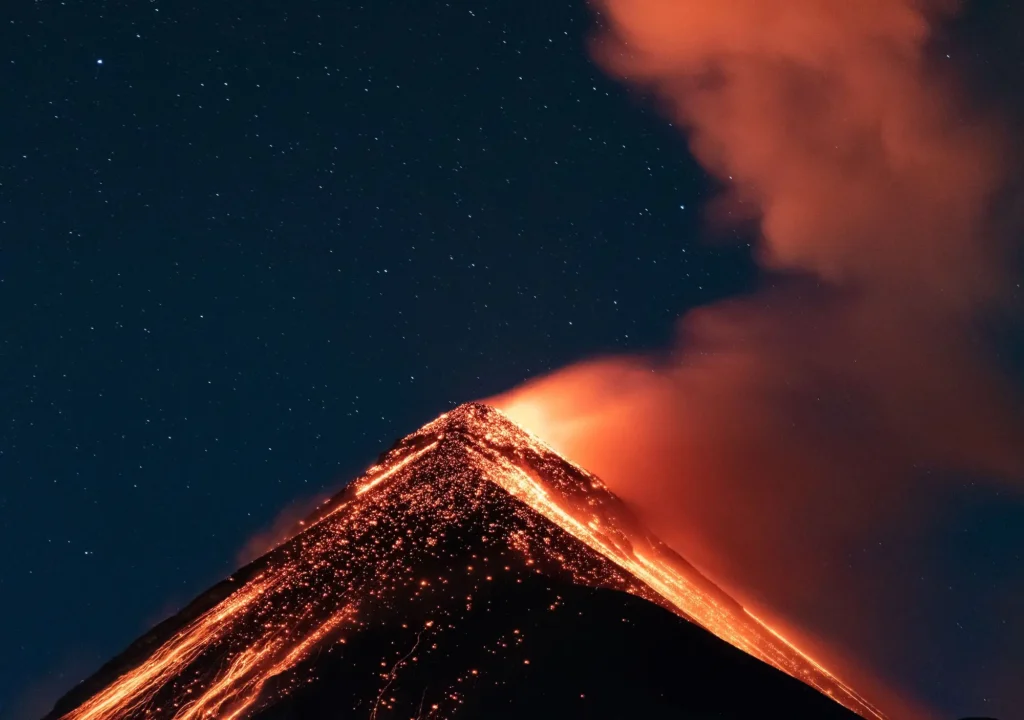
So you want to experience Acatenango? Let me guess… you saw a reel. The volcano erupting, some random person with a glass of wine in their hands, a blanket draped over their shoulders, the sky lit up in flames, and you thought: wow, I want that. I get it, that’s exactly how I ended up here too.
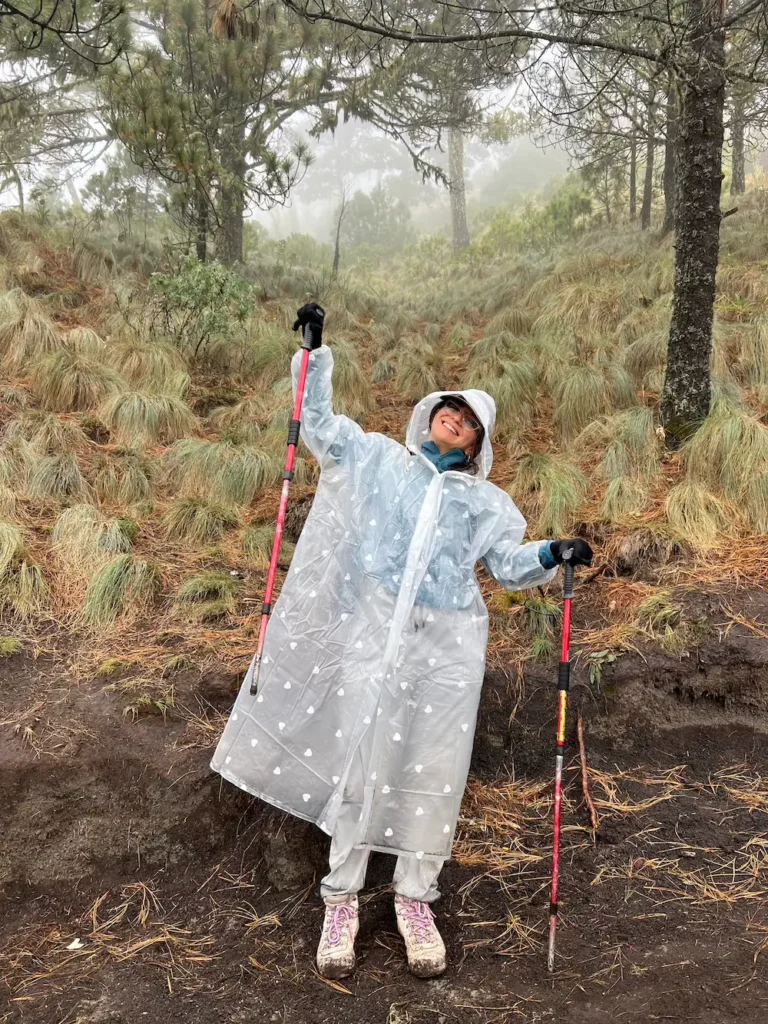
This article is dedicated to everyone who, like me, has never climbed a volcano, who’s anxious, and who, days before their trip to Antigua, is busy reading other people’s experiences to figure out whether or not to back out. Well, here I’m going to tell you every last bit of it.
My name is Danitza, I’m a mexican traveler / nomad, and I’ve spent over four years on a nonstop adventure around the world as a slow-travel digital nomad. Welcome to my blog! Here you’ll find useful information about the places I’ve visited and stories of my adventures.
This article is basically Acatenango for beginners, from a beginner who actually made it.
And first things first, I want to make it clear that I’m a traveler, but not a hiker. I’m from Cancun, the highest thing you’ll find there is a rooftop bar. So this story comes from the perspective of someone who decided to take on one of the most demanding mountain trails in Central America without practicing on a hill or something first lol.
If you’re nervous, if you’re not outdoorsy, if you’re reading this at 1am completely spiraling, wondering whether you can actually do it – you’re my people, stay, this one’s for you.
Why Did I Climb Acatenango?
To be honest, I had no idea what I was getting myself into when I convinced my friend to fly to Guatemala. Adri is a real hiker. Nepal level, multi-day-trek level, the kind who knows what a base camp in the Himalayas is. I’m the kind who decided to climb a volcano because of an Instagram post. And to me, that was the entire plan, that was my whole risk assessment.
It took me months to understand this was going to be more than a cute little adventure. Honestly, I didn’t bother researching it much until the date was pretty close. By the time I found out you had to climb to over 3,600 meters (about 11,800 feet) above sea level, Adri had already decided and arranged for her birthday celebration to happen at the summit, which turned the whole thing into an even more complicated commitment, and an even harder one to avoid.
The truth is, Acatenango is no joke. It’s a serious undertaking, but it’s not impossible either.
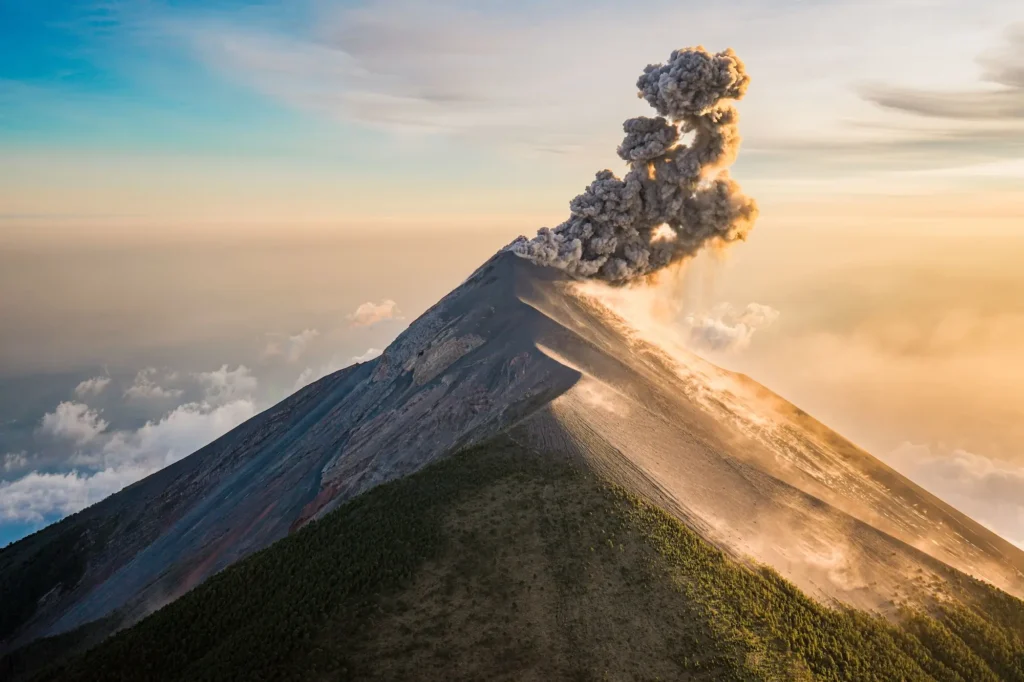
Preparation: Climbing Acatenango for Beginners
Before I tell you how I survived the climb, let’s talk about what happens beforehand. Honestly, a big part of whether Acatenango goes well or badly for you comes down to showing up well prepared.
First, Where You Start: Antigua
Ideally you start in Antigua, a charming little city in Guatemala that, if you’ve been to Mexico, will remind you a lot of Oaxaca. UNESCO named it a World Heritage Site in 1979 for its architecture and historical value.
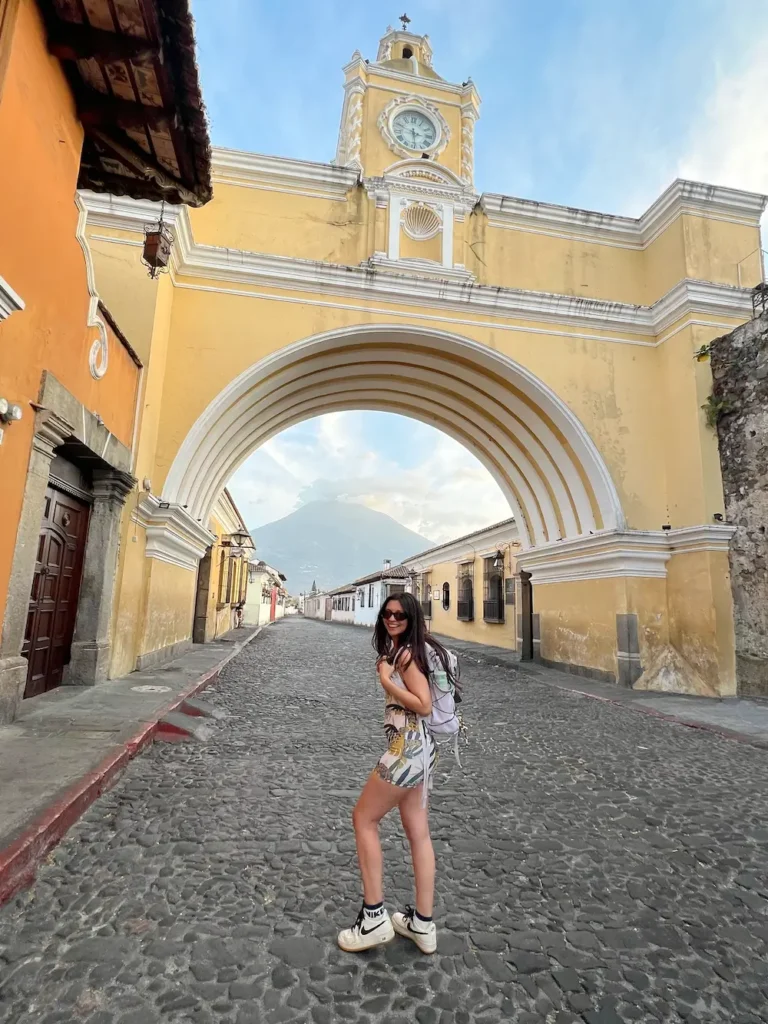
It’s easy to fall in love with Antigua fast, with its cobblestone streets, its colonial facades, its colors, and the Santa Catalina Arch – that yellow arch built in 1694 that’s become the symbol of the city and frames Agua Volcano in the background.
Antigua was Guatemala’s third capital and, for more than two centuries, it was one of the most important centers in all of Central America, until the Santa Marta earthquakes destroyed it in 1773 and the capital was moved to present-day Guatemala City.
A detail I loved: the name “Acatenango” comes from Náhuatl: “acatl” which means reed or cane, and “tenango” means place or hill, so, “the hill of the reeds.” As a Mexican, stumbling on Náhuatl on the other side of the border feels special. In fact, the word “Guatemala” also comes from Náhuatl, “Quauhtemalan“, which means “place of many trees.” And from what I read, even though Náhuatl is no longer spoken in Guatemala, it’s still present in its place names.
What Makes the Hike So Demanding: The Altitude
It’s recommended that you acclimatize to the altitude for a day or two in Antigua, which sits at about 1,545 meters (5,070 feet), so your body can get used to the oxygen levels, especially if you’re coming from sea level.
The hike starts in La Soledad at about 2,491 meters (8,170 feet), the campsite sits around 3,600 meters (11,800 feet), and the summit is at 3,976 meters (13,045 feet). In other words, you climb from 1,500 (~5,000 feet) to almost 4,000 (~13,000 feet) meters in less than 24 hours. That’s a huge elevation gain in very little time.
The thing is, the higher you go, the less oxygen there is, and if you climb fast it can hit your body hard. That’s exactly why my biggest fear was altitude sickness. Some people take medication before the hike to help their bodies cope with the altitude. In Antigua you can get a pill to take about 24 hours before the hike. Honestly, taking some random medication gave me more anxiety than the idea of dealing with however my body might react, so I decided not to take it and to trust going at my own pace (spoiler: my pace was painfully slow, and that probably helped).
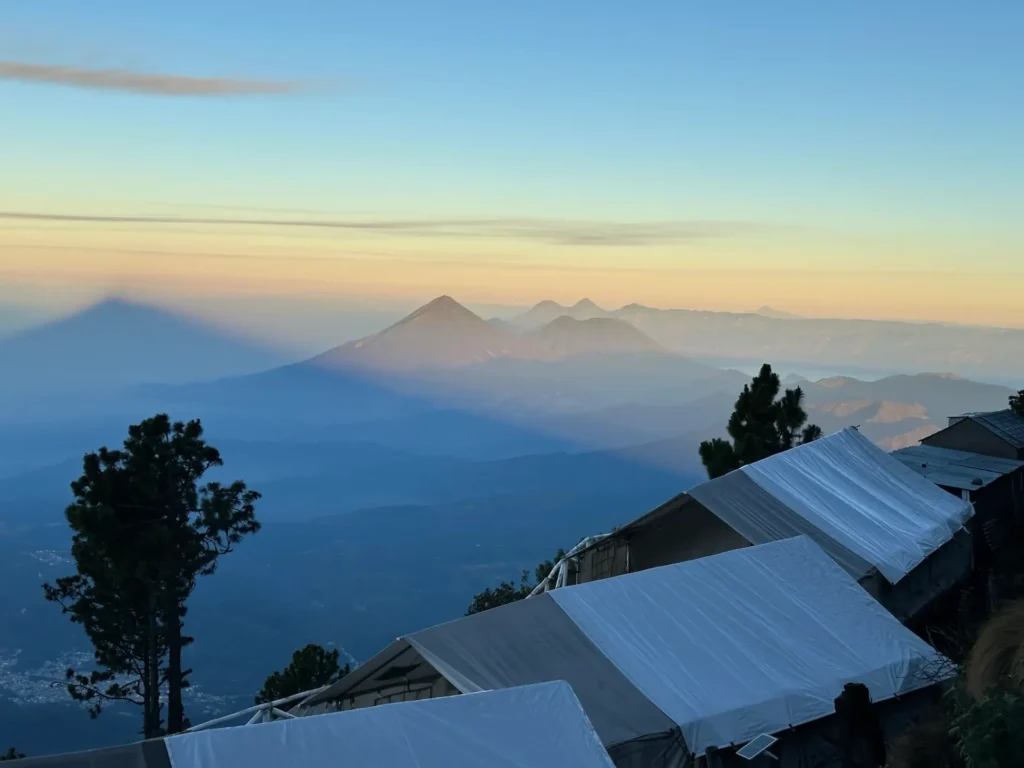
Book Your Acatenango Experience Early
This is one of the most popular tours in all of Guatemala, and it fills up. We booked well in advance, and even so, by the time we did, the only package left was the most basic one. So if you have dates, lock in your spot as soon as you can. The longer you wait, the fewer cabin and comfort options you’ll have left.
I booked with Tropicana, a hostel in Antigua, though I chose to stay somewhere else.
This isn’t a paid recommendation, it’s just the tour I bought. They have several packages (from the simplest to more comfortable “VIP” cabins), and all of them include the essentials: certified local guides, camping gear, food, and a campsite with one of the best views of Fuego Volcano.
One important detail worth mentioning: if you decide to go with another company, check carefully whether their campsite actually has a view of the volcano. While I was researching, I learned that a lot of campsites are scattered across different parts of Acatenango, and not all of them face Fuego. This matters a lot, because if you have the bad luck of ending up at a viewpoint with bad weather, your chances of seeing it at all drop significantly.
Frequently Asked Questions About Acatenango
How Hard Is Climbing Acatenango for Beginners? Do I Need Experience?
You don’t need technical experience, I had none, it was my first hike, but I won’t lie to you: it’s demanding. It’s between five and nine hours of almost continuous, steep climbing, at high altitude. If you do some cardio and leg strength work before the trip, you’ll thank yourself for it.
What to Pack for Acatenango?
The golden rule is: layers, layers, and more layers. You’ll go from being hot while walking under the sun to below 0 °C (32 °F) at night, all in the same day. The good news is that if you’re coming off a long trip and don’t plan on lugging certain things around, a lot of this can be rented there.
Clothing:
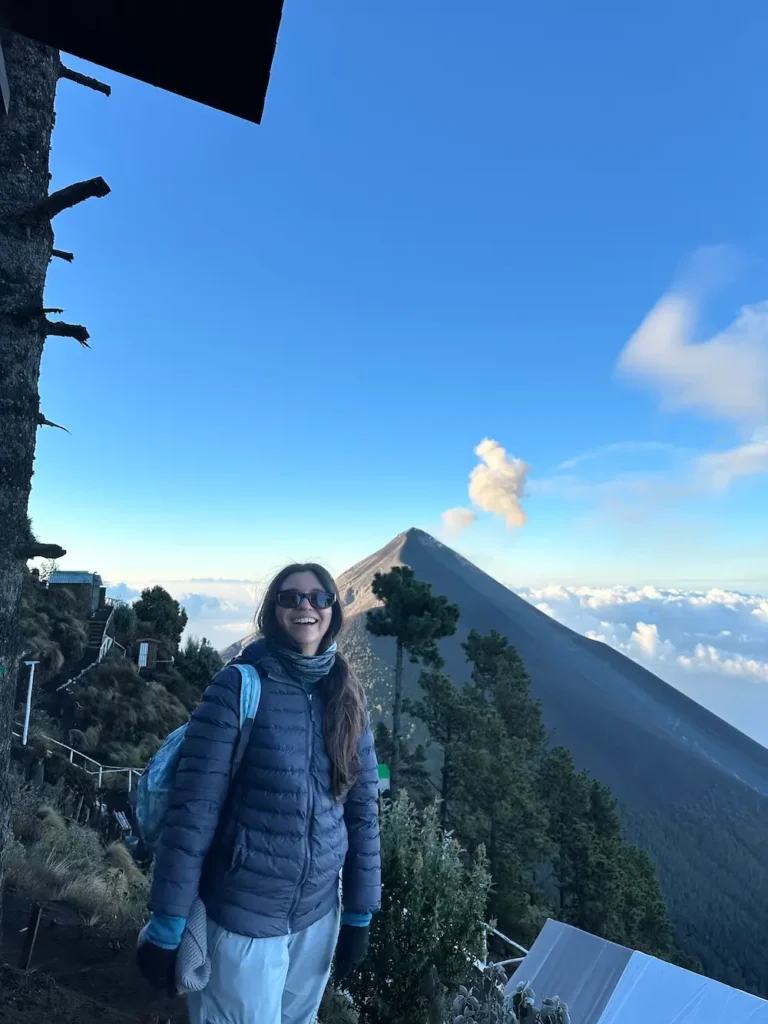
- Thermal layers / base layers, ideally two sets, one for hiking and a dry one for sleeping.
- A fleece. I have this one from The North Face that I bought just for this, and it ended up being an amazing addition to my travels. I had no idea something so thin could be so warm.
- A warm jacket and a proper windproof/waterproof layer. (Don’t be like me, who brought a totally impractical rain jacket.) *you can rent this there
- A beanie and gloves. You’ll desperately need them at night. *you can rent the beanie there
- Hiking shoes with good grip, please don’t do this in regular sneakers. I wore hiking boots, and thank goodness, because it rained the entire day. I saw a guy wearing the exact same white sneakers I have at home and was too close to packing. His were soaked, caked in mud, and sliding everywhere. Oh, and during my trip through Guatemala I ran into more than one person with a sprained ankle from climbing hills just like that, unprepared.
- Extra socks for the second day.
- A buff or bandana for the dust and the cold.
Other Items:
- A headlamp with good battery life, essential for the 4 a.m. summit climb *you can rent this there
- Sunscreen and sunglasses, at that altitude the sun is brutal.
- A power bank, because there’s nowhere to charge anything.
- Energy snacks, your body will thank you halfway up. I brought a mix of nuts and some protein and energy bars made of dates that I found at a supermarket in Antigua.
- Toilet paper, you don’t need a whole roll, but bring enough for two days.
- Hand sanitizer or wet wipes, up there, there’s nowhere to even wash your hands.
- Trekking poles, indispensable for both the climb up and the way down *you can rent this there
- A small bag for your trash, everything that goes up comes back down with you.
The good news is that Tropicana includes three borrowed garments with the tour, and you can rent extra for a small fee if you don’t have everything (which is likely, because who travels to Guatemala with clothes for freezing temperatures?). Ask what your package includes and figure out what you need to rent or buy.
By the way, my tour included 4 liters of water that you have to carry yourself, and 1 of those liters you hand over to the guide once you’re up there, because they use it to make hot drinks and soups at camp.
Should You Hire a Porter on Acatenango?
One of the best decisions I made was hiring a porter. They give you the option to hire someone to carry your backpack up to the campsite, and honestly, I’m not sure I would’ve made it without him. It costs around 35 USD for 10 kg (22 lbs), and it can be split between two people. I shared mine with Adri. So all I carried on my back was my daypack with snacks, water, and the basics for the trek up to camp.
When Is the Best Time to Climb Acatenango?
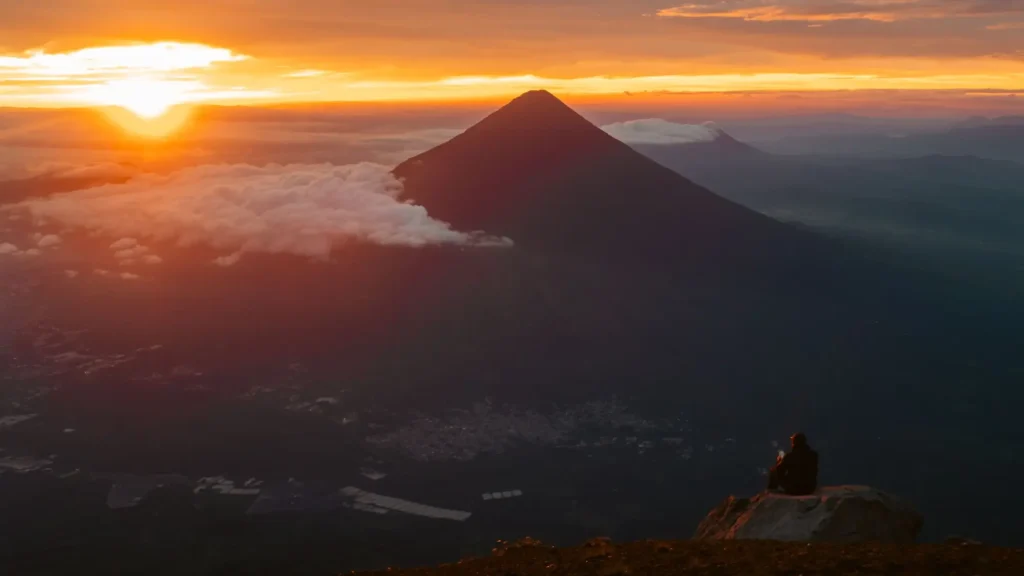
Guatemala has a dry season (roughly November to April) and a rainy season (May to October). If you want a better chance of clear skies to see Fuego, the dry season is your best bet; the coldest, clearest months tend to be December through February.
What Is Altitude Sickness and How Do I Manage It?
Base camp is close to 3,600 meters (11,800 feet), and the summit is at 3,976 (13,045 feet). At that altitude it’s common to feel symptoms: headache, nausea, dizziness, fatigue, or loss of appetite. To reduce the risk: spend a day or two in Antigua first (to acclimatize), hydrate a lot, climb at a slow and steady pace, and don’t overdo the alcohol the night before. If you’re prone to it, ask your doctor about bringing medication. I decided not to take anything and the slow pace worked for me, but every body is different.
What’s the Difference Between Base Camp and the Summit on Acatenango?
They’re not the same. Base camp (~3,600 m / 11,800 ft) is where you sleep, and where you can watch Fuego erupt all night long, for many people, the best view. The summit of Acatenango (3,976 m / 13,045 ft) is an additional, optional hike, usually before dawn (~4 a.m.), to see the sunrise and Fuego from the highest point. I stayed at camp and didn’t go up to the summit, and I don’t regret it one bit.
Are There Vegan or Gluten-Free Options on the Acatenango Tour?
Yes. With my tour there were vegan and gluten-free options at every meal. If you’re vegan like me, mention it when you book and confirm it so they can adapt your meals. And bring your own snacks, just in case.
Do I Need Travel Insurance for Acatenango?
For an activity like this, altitude, physical exertion, uneven terrain, I wouldn’t do it without insurance that covers adventure activities. Make sure your policy includes high-altitude trekking. I recommend Genki; it covers hiking and trekking with some restrictions, including a maximum of 4,000 m (about 13,100 ft).
My Experience Climbing Acatenango Volcano
⚠️ Before You Read: An Important Note (Updated 2026)
This is the chronicle of my experience climbing Acatenango, and I’m writing it as a personal account. I did this hike before the restrictions I mention below were announced. What I experienced, including my friends’ crossing to Fuego, was possible and permitted at the time; today the situation is different.
Fuego Volcano has seen increased activity in 2026, and Guatemalan authorities have issued restrictions. In particular, the crossing or ascent to Fuego Volcano (the hike my friends do in this story) was prohibited in April 2026 by the Municipality of Acatenango, along with staying in zones like El Camellón and La Meseta. Getting close to the crater carries serious risks: burns, injuries, respiratory problems, and even death, and disobeying the prohibitions can lead to penalties.
Something worth remembering: when you ignore a restriction, you don’t only risk your own life. In an emergency, you also endanger the rescue teams who would have to come after you, exposing themselves to an active volcano to get you out.
Conditions change constantly: a restriction can be put in place or lifted depending on the volcano’s activity. So before planning any climb:
- Check the current status from official sources, right before you travel:
- Smithsonian / USGS Global Volcanism Program – Fuego (weekly activity reports in English)
- INSIVUMEH – official daily volcano bulletins (in Spanish; primary monitoring source)
- Respect all restrictions and never approach Fuego’s crater, no matter how tempting the photo.
- Remember that nature is unpredictable.
Your life is worth infinitely more than any experience or photograph. Go carefully, go informed, and go with respect for the mountain, for those who live at its feet, and for those who would have to risk themselves to rescue you.
The Day of the Climb
The morning started out deceptively calm. The sky over Antigua was clear blue, the air mild, everything still. It looked like it was going to be a gorgeous day. We got to the hostel, ate breakfast, and listened to the guides run through the details of the tour.
I ate fast, my stomach in knots. I was about to do something I still couldn’t quite picture, and I downed my coffee without really tasting it. Then the chaos kicked in: backpacks dumped open everywhere, people lining up to try on jackets, beanies, and pants and tossing around the ones that didn’t fit. I went through the whole anxious last-minute inventory, asking Adri “Should I bring this? Think I’ll need that?” every two minutes. I rented a jacket and a beanie, and thank god I did, because I wouldn’t have lasted the night without them.
As we packed, the blue sky started bruising into gray, and the first drops began to fall. Barely a drizzle, but enough to make me second-guess: should I bring the rain jacket? The thing is, I’d bought mine in Vietnam, for exploring rice fields on a motorbike, not exactly volcano gear. It’s long, heavy, and a hassle to carry if you end up not needing it. “Bring it,” Adri said, no hesitation. And who was I to argue with the expert?
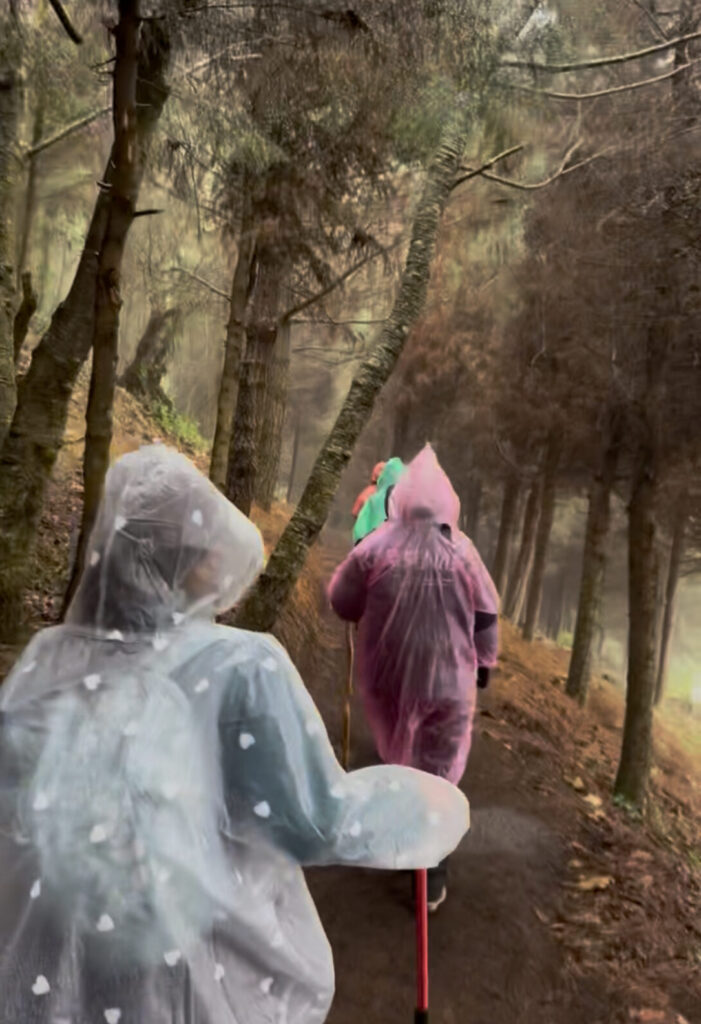
A bus took us to the trailhead, where we rented the rest of what we needed: headlamps and poles. While we finished gearing up, a bunch of people queued for last-minute disposable ponchos; by then it was obvious the sky wasn’t backing down. It had gone fully gray, and the cold was biting at my cheeks. I could see my breath as I talked, and my gloves were barely keeping my hands warm.
The guides pulled us together and walked us through the route. The porters loaded up our bags. When we were finally ready, I looked over at Andrew, my boyfriend, buried in so many layers he was almost unrecognizable. “Ready?” I asked him. He smiled and held out his hand. Good thing he didn’t ask me back, because I wasn’t. And just like that, hand in hand, we started marching toward the volcano.
Ahead of us stretched a line way longer than I’d pictured: people from all over the world, languages I couldn’t place, everyone inching forward in the same direction, after the same thing, to see Fuego. For a second, I stopped feeling so alone in my fear.
The Climb Up
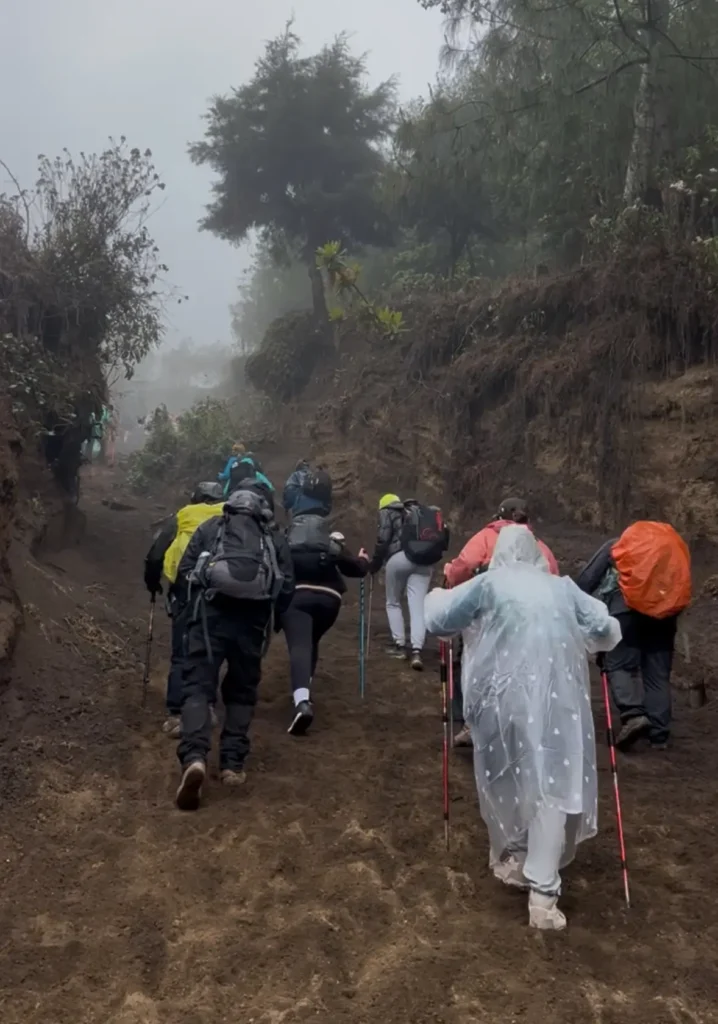
We set off into a cold I hadn’t planned for. Every photo I’d ever seen was somebody hiking under a warm, sunny sky; I knew the summit would be freezing, but I wasn’t ready for this cold from the get go. We weren’t even twenty minutes in when my breathing started to go tight. I did the math, five to seven hours of this?, and quietly began composing my resignation. What if I just turn back? I thought. But I’m already here. I have to at least try…
The trail just went up. And up. Not one flat stretch to catch your breath. The rain came and went in waves: sometimes it was just cold, then all of a sudden little rivers of muddy water would rush down the path, right where I was trying to climb.
The line that had felt like a crowd at the start thinned out little by little, until it was basically just Andrew and me. Adri and her friends were somewhere up ahead, moving at a steady rhythm behind the guide. I trailed way back, stopping every few minutes to catch my breath and, honestly, to catch the will to keep going.
I was colder than I’d been since traveling Europe in the dead of winter. My feet kept catching on the hem of that endless rain jacket, which was tearing and collecting mud with every step. The rain fogged and soaked my glasses until I could barely see, so I took them off, which left me basically blind – because I genuinely can’t make out a face from a few meters away without them. So there I was, halfway up a volcano, in the rain, nothing in focus but my own two feet. So that’s what I looked at. I barely have any photos of the way up; almost the entire trek lives in my memory as a pair of muddy boots. One foot, then the other. What am I even doing here? I asked myself, over and over.
Okay, pause. Am I scaring you? I swear that’s not the goal. But I’m not gonna sell you some prettied-up version that didn’t happen. You deserve the real thing. So just hang on. Let me finish being dramatic and get to the good part, because there is one.
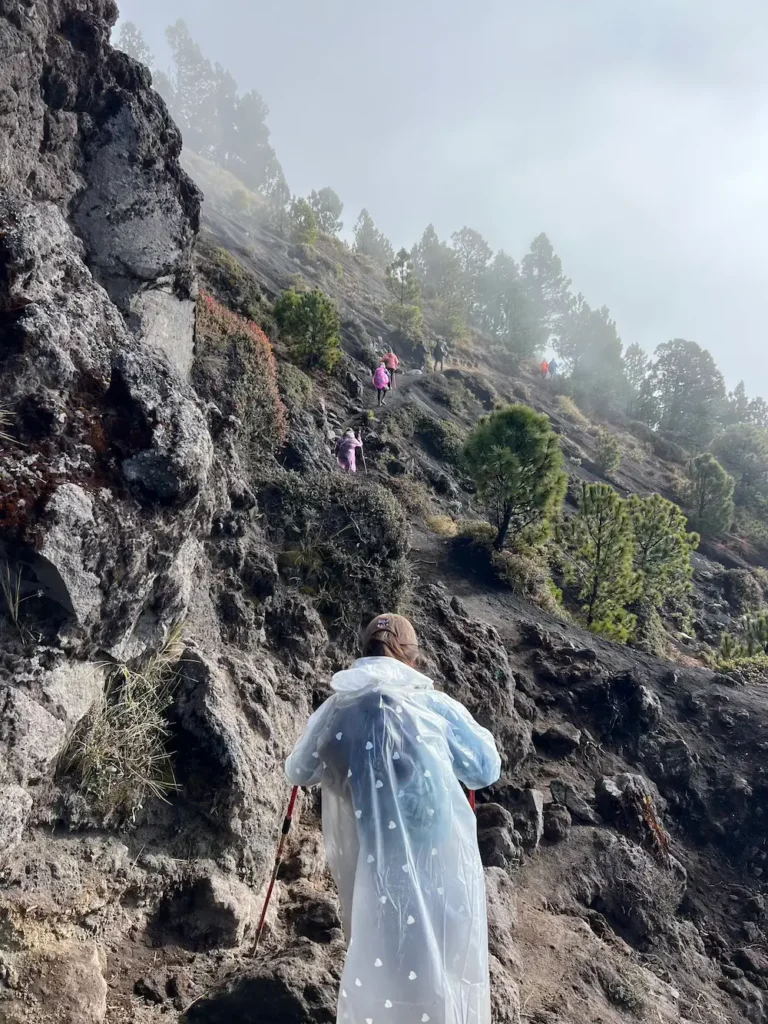
So, like I said: I was last. Not just in my friend group, dead last in the entire tour. If it weren’t for Andrew, I’d have basically climbed that volcano alone. He stayed right behind me the whole time, even though he could’ve gone so much faster. He’d sing so I could follow his voice without having to see him, and call out where to step or which way to turn. He never left. The guide would stop every now and then to wait for us, and still the gap between us and everyone else kept stretching, and I kept getting more and more tired.
I’d never taken on a climb this brutal.
I think my old weightlifting days did my legs a favor, because they held up way better than I had any right to expect. Under all those layers, hands frozen solid, my body was somehow on fire, the kind of warmth only your own effort can produce. My chest was the real problem. For most of the way up I had a pressure in the center of it, that feeling when you sprint flat-out and your lungs empty in one shot, except it didn’t go away. The altitude was catching up with me, and I could feel every bit of it.
Go slow. Go at your own pace. Let them go ahead. Don’t push it. I repeated it like a mantra. And honestly, that crawl of a pace was probably the thing that spared me from real altitude sickness.
Small mercies, the kind life hands you right when you need them most.
Arriving at Camp
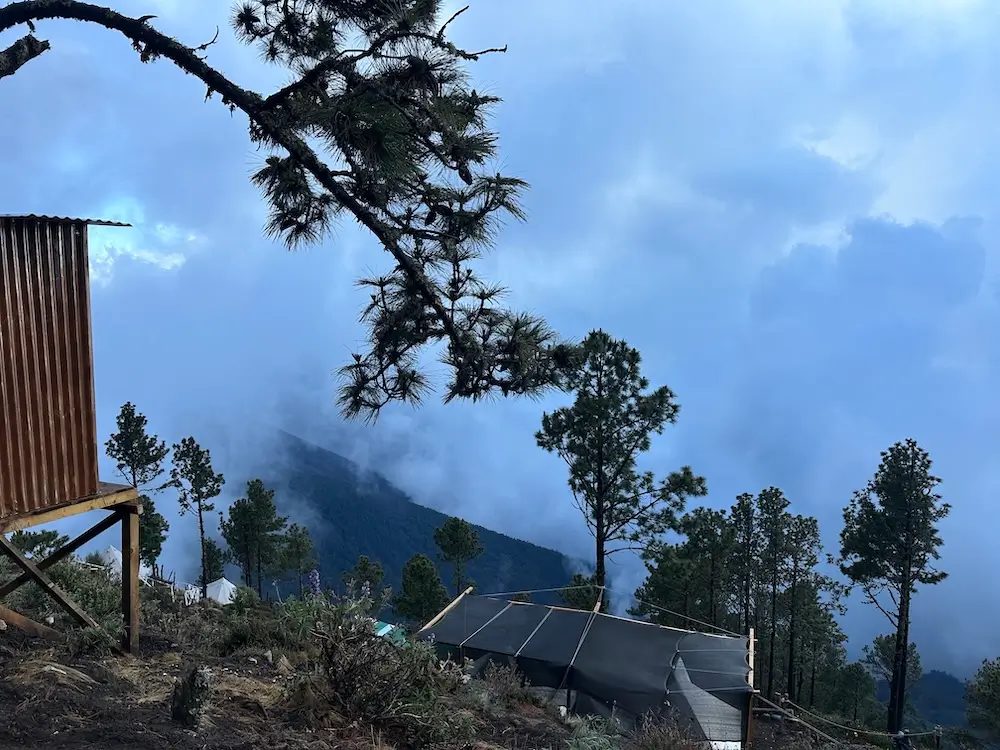
We stopped a few times along the way, to eat or regroup. Those were the only moments I actually shared with the rest of the tour: we’d catch our breath as a group, and then the second everyone set off again, I’d drop to the back.
“This is the last stop before camp,” the guide said, on a stretch of trail that smelled like pine.
What came next was one of the most beautiful views of the whole climb: a spot they call the Y, where the trail splits open above the clouds. And there, finally, the sun was back on my face. And finally, the ground went flat.
My chest loosened up by the minute; without that slick, punishing incline dragging at me, my pace actually picked up. “You can see Lake Atitlán from here,” someone said. I started shedding layers, rain jacket, jacket, beanie, one by one. With every piece I peeled off, I felt lighter.
“Are we almost there?” I asked.
“Just around the corner,” the guide said.
Relief flooded me, before I’d even set foot in camp.
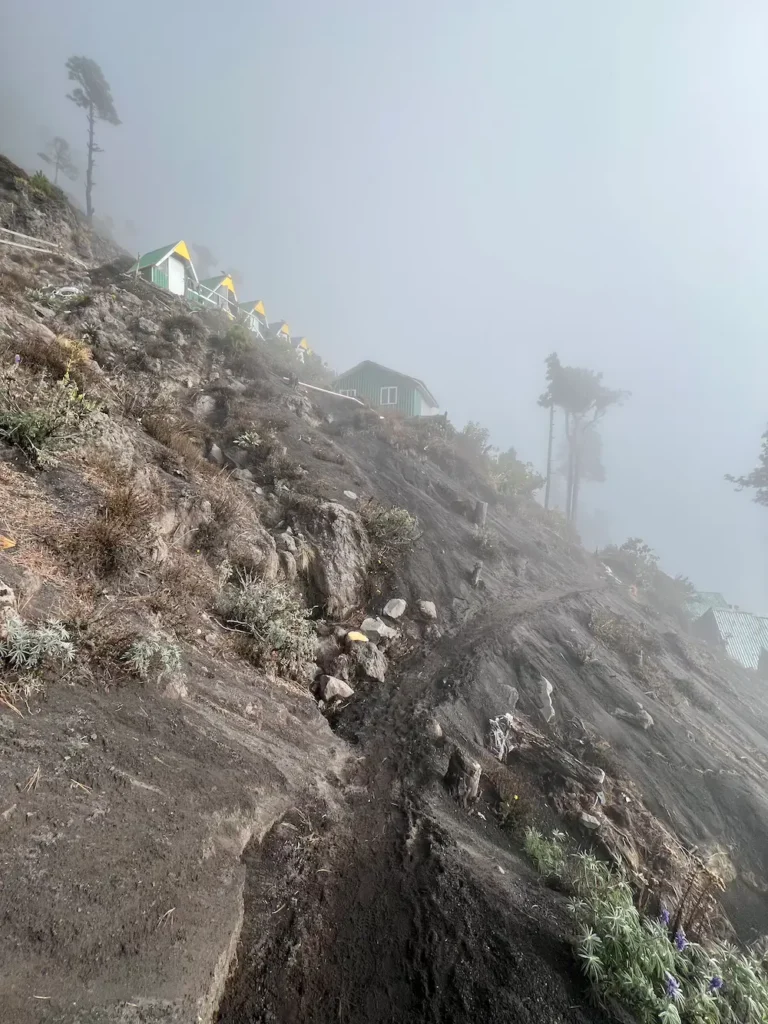
We picked our way across a rocky stretch, hopping stone to stone, rounding the volcano, and then, exactly where Fuego was supposed to appear for the first time, there was a wall of cloud swallowing the whole campsite. Just like that, sun and open sky turned to fog.
As usual, everyone went ahead, and Andrew and I got left behind. I couldn’t see more than two or three meters out, even with my glasses back on. Little cabin roofs surfaced out of the mist, scattered among the rocks like ghosts.
We got a little lost, until a guide from another tour pointed us the right way. “You’re just a few minutes out.” I could hardly believe it.
Our own guide, who’d come back to look for us, found us and walked us to the cabin. The rest of the group was already inside, settling in. It was tiny, the eight of us barely fit. A few sheets of plywood held one sleeping bag after another after another, crammed shoulder to shoulder. There was maybe half a meter of floor to move along the length of the little room where we’d spend the night.
And then I heard it: the roar of the volcano erupting just meters away. I bolted out of the cabin, and that massive cloud had it completely hidden.
“We’re not sure it’ll show,” the guide told us. “It’s pretty socked in, honestly.”
“Does it ever happen that you see nothing at all?”
“It does,” he said. “That’s nature, no promises. People have come up and seen nothing. Hopefully it clears later. Yesterday was perfect, not a cloud, no rain. Today, though… well, you know…” And as he said it, he handed us our hot soup.
Deciding Whether to Cross to Fuego
“We’ll let you know later if the Fuego group is happening,” he said. “Just so you know, that part isn’t through Tropicana, it’s directly with us guides. If you want in, decide, if it’s a go, we leave at six. Depends on the weather… though I’m not hopeful. This late, if it were going to clear, you’d see it by now.”
The Fuego hike costs extra, something we already knew going in, they tell you when you book, and it’s arranged separately, straight with the guide.
“Are you going?” Andrew asked, as if he hadn’t just witnessed what it took me to get up Acatenango in the first place.
“I don’t think so, love. Hopefully it shows from up here, and if not, maybe I’ll catch it tomorrow on the summit. You?”
“Yeah, I think I am.”
About an hour later, somewhere between peeling off my wet clothes and finishing my soup, Adri came into the cabin with the news: it was clearing. You could already see a sliver of it.
I bundled back up and went out, and there I was, face to face with the fire volcano. The sky had opened up and the colors of the sunset were starting to rise. But there was still a cloud hanging between me and the volcano, like it had decided to cover that one thing and nothing else. I looked down at the clouds from above, and watched the sky go orange as the minutes passed.
“The Fuego tour’s on,” someone called.
The guide turned to me, hesitant. “Are you going?”
“No, I’m staying. I barely made it up here as it is,” I laughed.
“Good,” he said. “It really is a tough route. There’s nothing wrong with knowing your limits, a lot of people don’t, and they suffer. Head over to the main camp so you’re not on your own, and wait for your friends by the fire. It looks like the rest of your group is going.”
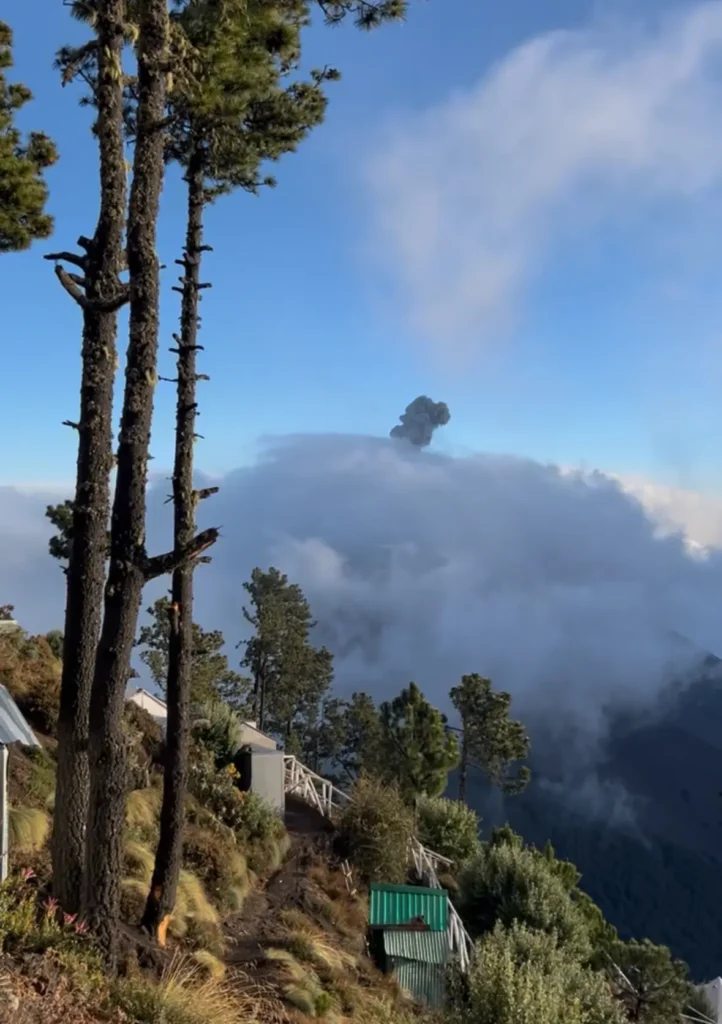
I stood there a while, watching the volcano, still tucked behind its little cloud. And then, another blast. Ash shot up and rained back down in gray. It was the first time I’d ever watched a volcano erupt. Hidden and all, it was happening right in front of me.
Face to Face with Fuego
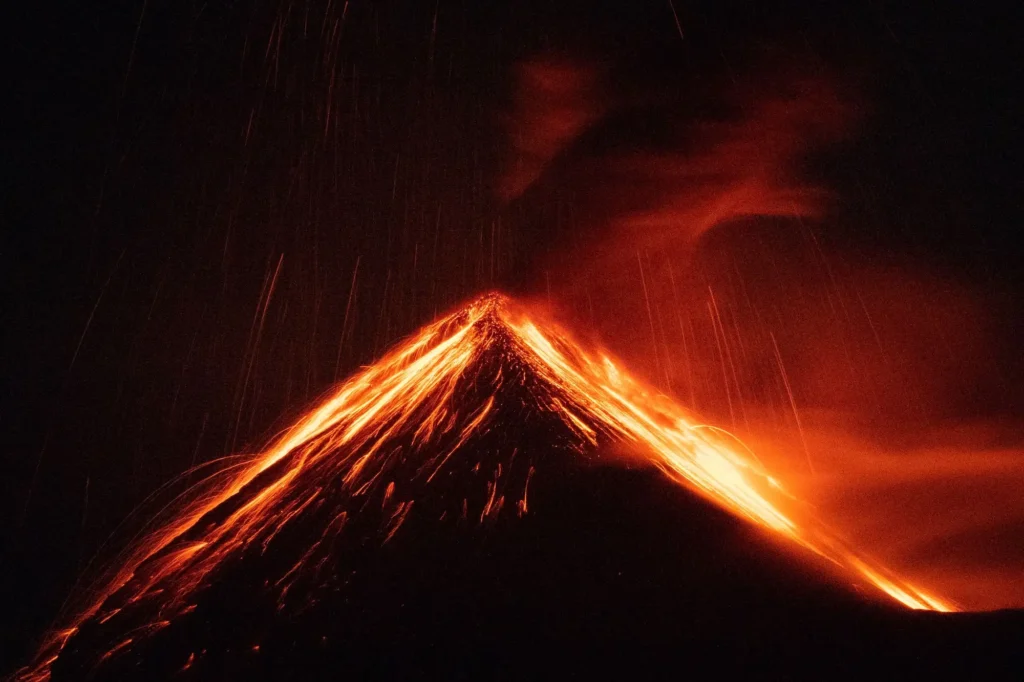
The Fuego group headed out, and I was alone in the cabin, not sure what to do with myself. I sorted my things and walked the few meters over to the main camp, sat down right as they were stacking the logs for the fire, and that’s the moment the sky finally cleared.
Now I could see Fuego erupt with nothing in the way. Gray ash blew out hard and spilled down the slopes. Every explosion sent a ripple of “wooow” through the people around me, all of us gasping at once, while the sun finished sinking and the lava glowed brighter and brighter against the dark.
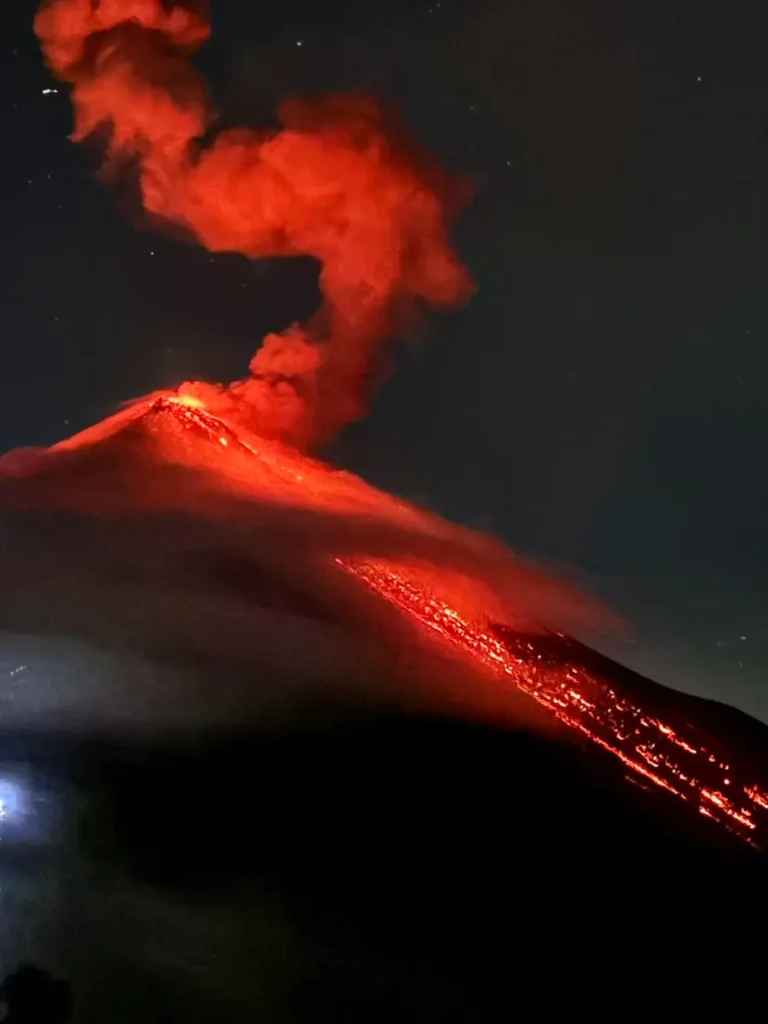
The fire caught, and the handful of us who’d stayed gathered around it, the volcano in full view. Someone broke out wine; the guides passed around dinner, then chocolate and marshmallows to roast. I didn’t know a soul, so for a while I just sat there quietly, taking it all in.
I held my hands to the flames and felt the warmth come back into me. And with every eruption, I felt a little more sure I’d made the right call for myself. Before he left, Andrew had kissed me and asked one more time, “You sure you’re not coming?” “I’m sure,” I said, even if some small part of me wasn’t.
Watching that volcano go off, more than twenty times over the hours I sat there waiting, wore away every last bit of the doubt.
“The ones who left are probably miserable right now,” a guy said, calmly sipping his hot chocolate.
“Honestly, staying was the move,” someone else said, crouched by the fire turning their marshmallows. “I bet they haven’t even seen it erupt yet, you can’t see it from the trail, and it was hidden when they left.”
He was right. I just wouldn’t find that out for a few more hours.
I don’t need to see it any closer, I thought. I’ve got it right here.
The Ones Who Crossed to Fuego
Once it was fully dark, the volcano hid again. By then I’d watched it erupt a good twenty times, and from the fire you could pick out a string of lights crawling toward it, like glowing ants, some headed out, some headed back, all on the same thread of trail.
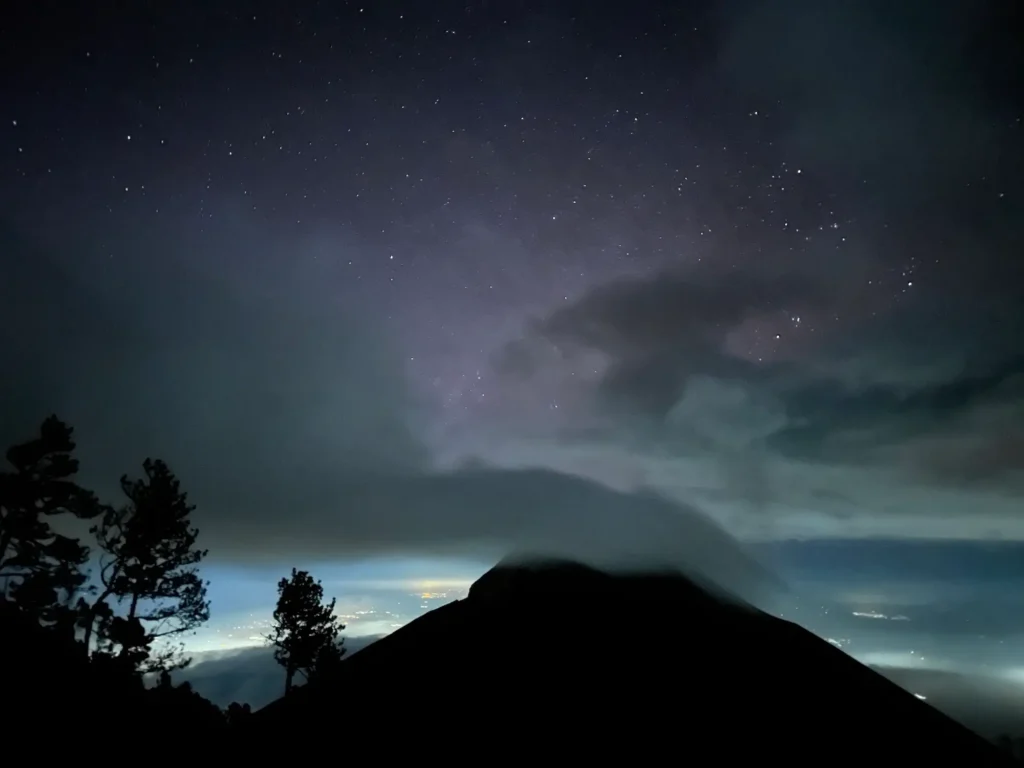
A girl from another tour sat with us to wait for her group, she had just seen it up close. Her group had fallen behind and she’d gone on ahead. She told us there’s something unreal about sitting in front of an erupting volcano, feeling the ground shake under you, watching Fuego burst open just meters away.
“I’ve never felt anything like it,” she said. “But the route is brutal. You descend Acatenango and climb right back up, the whole thing on this razor-thin trail with barely any visibility. Rocky, slippery.” She paused. “They’ll be a while. When I was coming back, there were still groups just heading out.”
She wasn’t wrong. My group was gone for five hours. They came back in pieces: first Adri and a few of the girls, then a few more, and finally, at last, Andrew.
“Love!” I caught him in a hug and a kiss. He had a grin stretched clear across his face. “How was it?”
“So hard. My knees have never hurt like this,” he said. “By the time we got there, a cloud had just rolled in. We saw one explosion, through the clouds. Feeling the roar and watching the lava run down the slope was incredible. The actual blast, though, couldn’t really see it.”
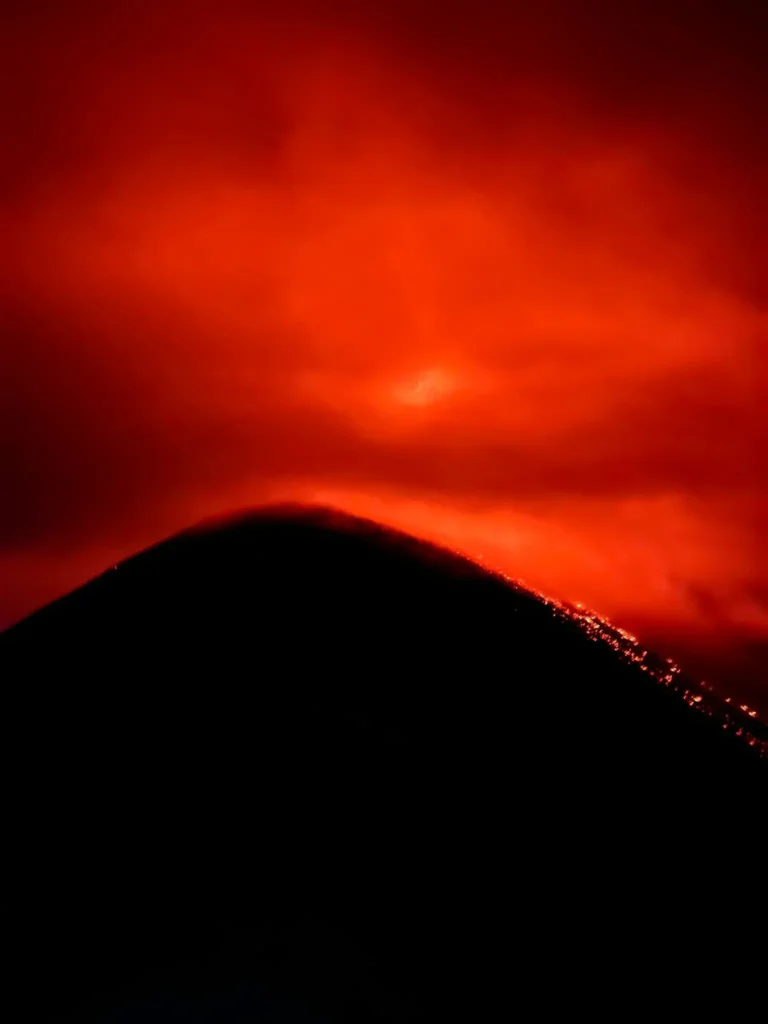
He showed me a photo. The sky was on fire, completely red, you could see the base of the volcano but not the peak. It looked like every image I’d ever held in my head of hell, or the earth at the end of the world. A red haze wrapped the summit, and off to the side you could just make out the lava sliding down in ribbons of flame.
That’s nature, though. Some go up and see it, some don’t, some catch it halfway.
“Was it worth it?” I asked.
“Yeah. It was incredible.”
He confirmed what I’d already guessed: you can’t see it from the trail. They never got the clear shot of the volcano throwing lava into the open sky, because by the time they made it back, camp had clouded over again.
Everyone got the experience they came for, and that’s what counts. I didn’t need it up close, I wanted to watch it explode. They went to feel it in their chests, sitting on its flank while it erupted.
The Night at Camp
We turned in. We wedged ourselves into the sleeping bags, packed in side by side, Andrew next to me. My socks were soaked and my feet were blocks of ice. I slept in every layer I’d hiked in and my skin still burned with cold. Honestly, I barely slept, I’d just start to drift off and the hard plank under us would dig into my back and pull me right back out.
In the middle of the night came the loudest blast of the whole trip. I felt the cabin’s wood shudder around me. It scared me, but it also thrilled me.
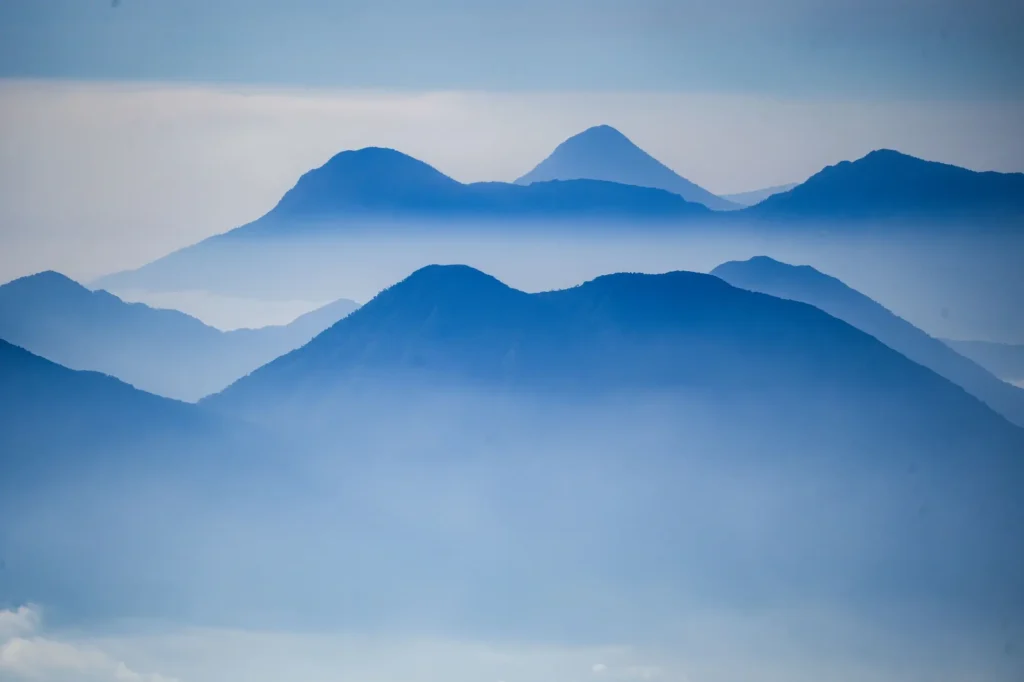
Before dawn, another group set out for the summit to catch Fuego one more time. I skipped it. I was completely full from everything I’d already gotten, and I’d rather rest and save my legs, there was still the descent ahead.
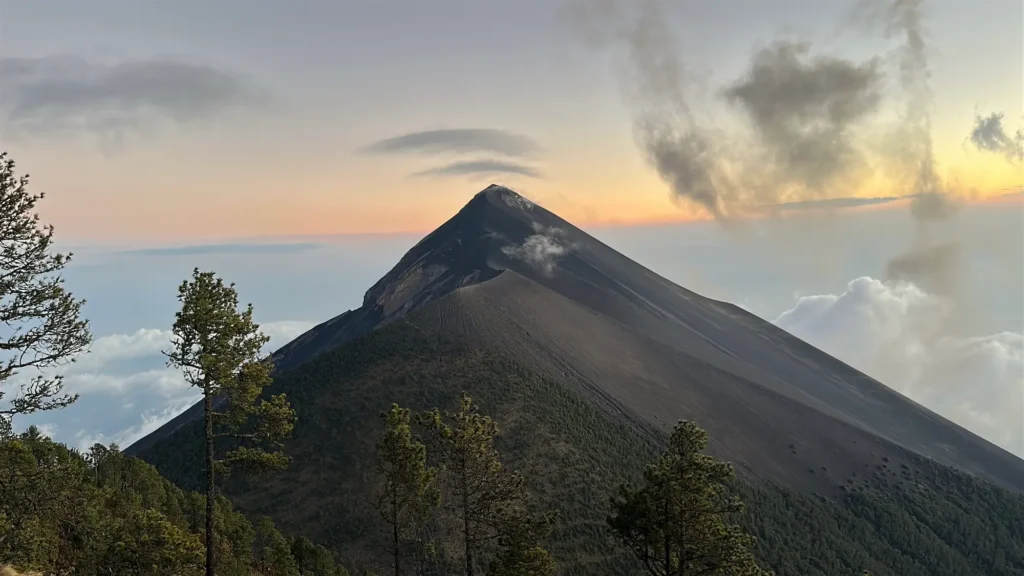
I stepped out of the cabin near the tail end of sunrise. I caught a few last threads of orange slipping through the clouds, and the volcano huge again, looming, breathing out gray smoke. We had breakfast and started packing up to head down.
The summit group filtered back. Curiosity was eating at me, so I asked around, and they showed me their shots. Stunning, all of them. And still, I didn’t feel an ounce of regret. In the end, the view wasn’t all that different.
The day was clear. The rain didn’t look like it was going to give us any trouble on the way down.
The Descent
We left camp toward the Y. Right before we rounded the volcano, I turned back for one last look at Fuego, and right then it let one go, like a send-off.
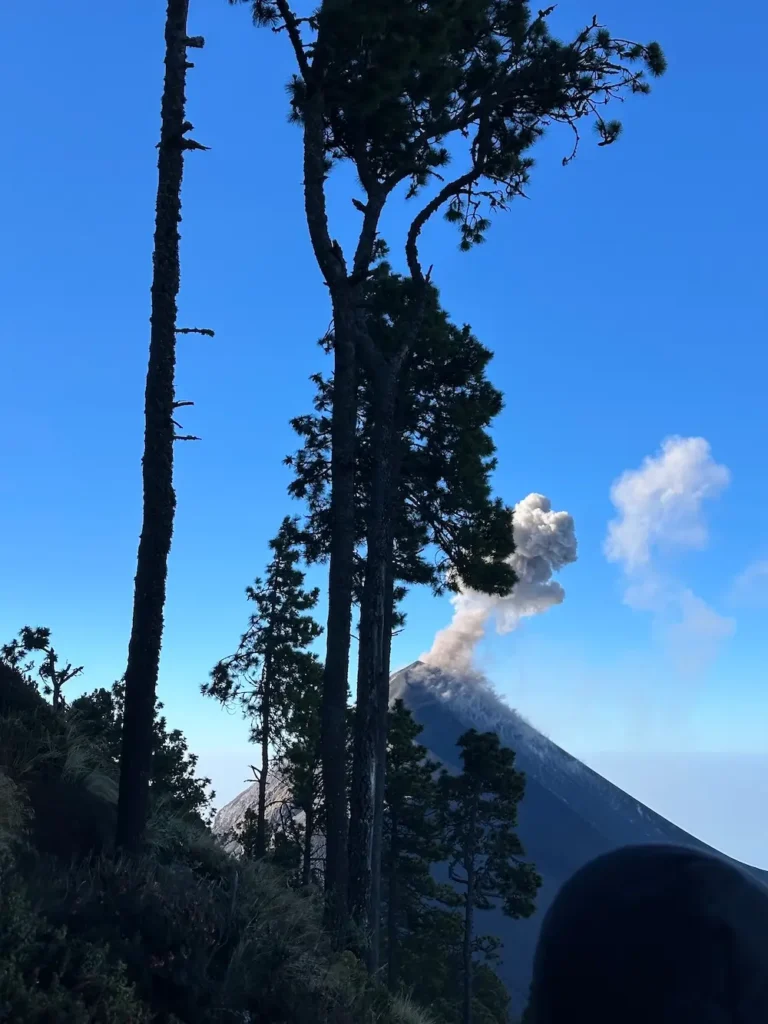
We got out ahead of the hostel group, but they caught us at the Y. We’d become one long line of people, my crew: Andrew, Adri, and the rest, up at the front. We filed across the narrow trail one by one, until the descent began. As the slope widened the path out, some pulled ahead and the rest of us drifted back.
Going down was nothing like going up. The day was sunny and warm, and the lower we got the hotter it became, so I kept stripping off layers as I went. The trees were a vivid green, blue sky flickering through the branches. The path wasn’t mud or puddles anymore, just dry, loose dirt. Not that the lack of water made it any less slippery.
This time, too, Andrew and I ended up at the back. Except now it was his knees, every step landed his whole weight on them.
Our guide hung back with us the entire way down. “How’re you two doing? All good?” he kept checking in. “Your group went ahead, I told them to, pointed them the way. I’ve got you. My advice: try to go faster, even run if you can. It’s actually easier on the knees that way, just be careful.”
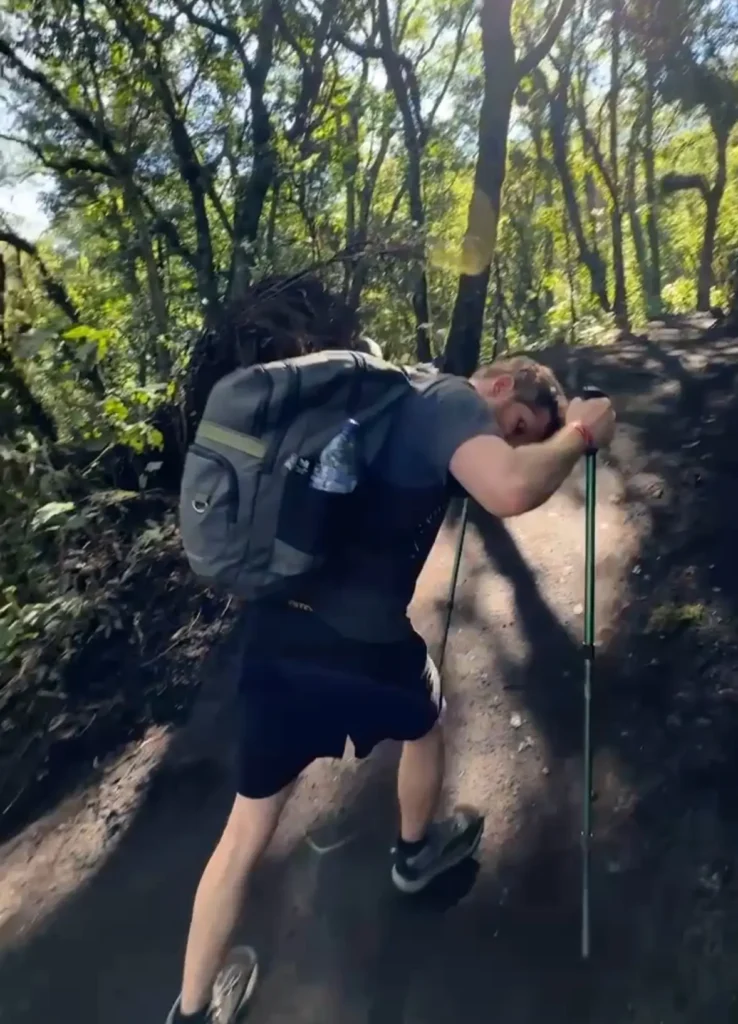
I tried it, and he was right. Running down was easier, somehow; I leaned on the poles to keep from falling.
Andrew, on the other hand, figured out that going down backwards worked better for him. So that’s how he came down, literally backwards, the whole way. People kept passing him and grinning.
“Guy’s out here doing the moonwalk,” somebody said.
And so, letting him cover some ground and then running to catch up, or the other way around, we made it all the way down, back to that same stretch where, the day before, I’d been so sure I wouldn’t.
We reached the trailhead a little past noon. Solid ground again. Body wrecked, legs shaking, but in one piece. We climbed onto the bus back to Antigua, and as the city came back into the windows, the mild air, the cobblestones, I could hardly believe that just a day earlier I’d been drafting my resignation halfway up a volcano.
You Don’t Have to Arrive Without Fear
I was scared of this volcano for months. I took it to therapy, I avoided it, I built it into a monster long before I ever met it. And I wasn’t entirely wrong, it was hard. One of the hardest things I’ve ever done. But what I hadn’t understood, the thing no reel was ever going to teach me, is that I didn’t have to show up fearless. I just had to show up.
I wasn’t the fastest. I was last. I didn’t summit, I didn’t cross to Fuego. And every single time I chose to hang back, I was choosing to listen to myself. Turns out that’s a kind of courage too, knowing how far you actually want to go, and not letting anyone make you feel like your version counts for less because it looks different. I didn’t need it up close. I wanted to watch it explode, twenty eruptions, right in front of me, after the hardest day I can remember in four-plus years of traveling the world.
Because here’s what it finally taught me: I didn’t beat the fear. I went with it. There were stretches where it had me by the throat, by the chest; others where it had me doubting every choice I made. And even with that voice going “you’re not going to make it, you’ll end up turning back“, I made it. I didn’t conquer anything. I just widened what I thought was possible. That’s why I reach for more now. I know my limit doesn’t stop at 3,700 meters above sea level.
So if you’re reading this with your stomach in knots, wondering if you could actually do it, you, the one who isn’t a hiker, who’s scared, who maybe comes from sea level and from anxiety, let me tell you what I wish someone had told me: you can go slow. You can come in last. You can skip whatever your body tells you to skip. You can be scared the entire way.
None of it takes away your right to be up there, watching the night burn.